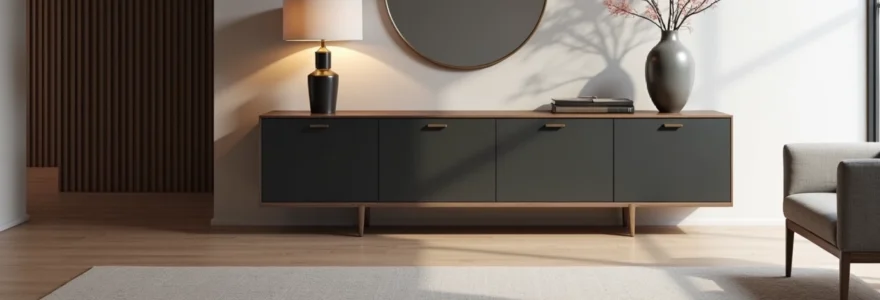
Console tables have emerged as the unsung heroes of contemporary interior design, transforming from historical furniture curiosities into essential elements of modern living spaces. These versatile pieces offer the perfect marriage of function and form, addressing the unique spatial challenges of today’s homes whilst serving as sophisticated design statements. Their resurgence reflects broader shifts in how we approach interior design—prioritising flexibility, sustainability, and aesthetic impact in increasingly compact living environments.
The contemporary console renaissance speaks to a fundamental change in home design philosophy. As properties become smaller and more expensive, furniture must work harder to justify its presence. Console tables excel in this demanding landscape, offering storage solutions, display opportunities, and workspace functionality without the footprint demands of traditional case goods. Their narrow profiles make them ideal for the tight spaces that characterise urban living, whilst their visual lightness prevents rooms from feeling cluttered or overwhelmed.
Modern manufacturers have responded to this demand with unprecedented innovation in materials, construction techniques, and styling approaches. From engineered stone surfaces to powder-coated steel frameworks, today’s console tables represent a sophisticated fusion of traditional craftsmanship and cutting-edge manufacturing processes. This evolution has positioned the humble console as a cornerstone of contemporary interior design strategy, capable of anchoring entire room compositions whilst adapting to changing lifestyle requirements.
Historical evolution of console tables: from georgian demilunes to contemporary statement pieces
Georgian and regency console heritage: bracket tables and pier glasses
The console table’s lineage traces back to 17th-century French court furniture, where these wall-mounted pieces served as platforms for candelabra and decorative objects in grand salons. The Georgian period witnessed the evolution of the console desserte , transitioning from purely decorative wall brackets to more substantial furniture pieces. These early examples featured elaborate carved legs, often incorporating acanthus leaves and shell motifs, with marble or painted wood tops that reflected the period’s taste for classical refinement.
During the Regency era, console design embraced the archaeological discoveries of Pompeii and Herculaneum, introducing Egyptian and Greek Revival elements that would influence furniture design for decades. The partnership with pier glasses—tall mirrors positioned between windows—established the console’s role as both functional surface and optical enhancer, a relationship that remains central to contemporary interior design approaches.
Mid-century modern console revival: florence knoll and george nelson designs
The post-war period marked a revolutionary departure from ornate historical precedents, with designers like Florence Knoll introducing clean-lined console tables that embodied modernist principles. Knoll’s approach emphasised honest materials and functional geometry, creating pieces that served multiple purposes without sacrificing aesthetic coherence. Her console designs featured hairpin legs and floating tops that seemed to defy gravity, establishing visual lightness as a core principle of modern console design.
George Nelson’s contributions to console evolution focused on modular thinking and systematic design approaches. His action office concepts influenced how consoles could function within open-plan environments, leading to designs that incorporated cable management and technology integration decades before these became standard requirements. Nelson’s console tables demonstrated how modernist furniture could adapt to changing work patterns and domestic arrangements, presaging many of today’s multi-functional design solutions.
Postmodern console interpretations: memphis group and philippe starck innovations
The 1980s postmodern movement challenged modernist orthodoxy with bold colours, unexpected materials, and deliberately provocative forms. The Memphis Group’s console designs rejected the notion that furniture should be anonymous or self-effacing, instead celebrating objects that demanded attention and sparked conversation. These pieces incorporated laminated plastics , artificial marble, and vibrant colour combinations that transformed console tables from background elements into sculptural statements.
Philippe Starck’s approach to console design during this period exemplified the decade’s fascination with celebrity designers and branded furniture. His pieces combined high-tech materials with organic forms, creating consoles that functioned as both furniture and art objects. This period established the precedent for designer console collections that would become increasingly important in luxury interior markets, demonstrating how these pieces could command premium prices whilst delivering exceptional design value.
Contemporary luxury console makers: tom dixon, west elm, and CB2 collections
Today’s console market spans from accessible contemporary designs to museum-quality art pieces, with manufacturers like Tom Dixon leading the charge in material innovation and sculptural form-making. Dixon’s approach combines industrial materials with craft techniques, creating consoles that blur the boundaries between furniture and sculpture. His use of beaten copper , cast bronze, and hand-blown glass reflects a broader trend towards celebrating visible craftsmanship in contemporary furniture design.
Mass market retailers like West Elm and CB2 have democratised sophisticated console design, offering pieces that incorporate high-end materials and design principles at accessible price points. These collections demonstrate how effective design can transcend price categories, with thoughtful proportions and quality construction making stylish console tables available to a broader audience than ever before. The success of these collections validates the console table’s central role in contemporary home furnishing strategies.
Spatial efficiency solutions: console tables in Open-Plan living architectures
Narrow profile furniture for compact urban dwellings
Urban living conditions have fundamentally altered furniture design requirements, with console tables emerging as perfect solutions for space-constrained environments. Their typical depth of 12-18 inches allows placement in corridors, behind sofas, or against walls without impeding traffic flow or overwhelming modest room proportions. This spatial efficiency becomes particularly valuable in studio apartments and converted lofts, where every square foot must justify its existence through multiple functions and aesthetic contributions.
The vertical emphasis of console design creates visual height without claiming floor space, making rooms appear larger and more gracious than their actual dimensions might suggest. Modern console manufacturers have embraced this principle, developing pieces with elevated proportions and glass or acrylic components that maintain sightlines whilst providing necessary surface area. These design strategies prove especially effective in narrow townhouse layouts and compact urban condominiums.
Multi-functional console integration: storage, display, and workspace consolidation
Contemporary console tables have evolved far beyond simple surface provision, incorporating sophisticated storage solutions and workspace functionality that addresses modern lifestyle demands. Hidden drawers, integrated wine storage, and cable management systems transform these pieces into comprehensive furniture solutions that replace multiple separate items. The most successful designs balance visible display areas with concealed storage, allowing homeowners to maintain clean aesthetic lines whilst accommodating practical necessities.
The work-from-home revolution has accelerated demand for console tables that function as secondary workstations , equipped with power outlets, keyboard trays, and document storage. These hybrid pieces enable flexible working arrangements without requiring dedicated office furniture that might overwhelm residential spaces. Console manufacturers have responded with designs that seamlessly transition between decorative and functional modes, supporting both daily work activities and evening entertainment requirements.
The most effective modern console designs serve at least three distinct functions whilst maintaining visual coherence and spatial efficiency—a testament to contemporary furniture design sophistication.
Room divider applications in loft and studio apartment layouts
Open-plan living presents unique challenges for spatial definition and privacy creation, challenges that console tables address through strategic placement and design. When positioned perpendicular to walls or floating within room centres, console tables create subtle boundaries between living zones without compromising the openness that makes loft living desirable. Their low profiles maintain sightlines whilst providing psychological separation between activities and functions.
Double-sided console designs specifically address open-plan requirements, offering finished backs and storage access from multiple directions. These pieces enable flexible furniture arrangements that can evolve with changing needs or seasonal preferences, supporting the adaptability that contemporary living demands. The most sophisticated examples incorporate rotating elements or adjustable components that maximise their space-defining capabilities whilst preserving aesthetic appeal from all viewing angles.
Entryway console systems: mail organisation and key storage solutions
The entryway console has become an essential element of organised modern living, providing dedicated space for daily routines and practical necessities that might otherwise create visual chaos. Contemporary designs integrate specialised storage for keys, mail, electronic devices, and seasonal accessories, transforming potentially cluttered transition zones into composed, welcoming spaces. These organisational systems often incorporate charging stations and device docks that address technology integration requirements without compromising aesthetic appeal.
Entryway console design must balance accessibility with security, providing convenient storage for personal items whilst maintaining clean visual presentation for guests and family members. The most effective designs incorporate hidden compartments and lockable storage alongside open display areas for decorative objects and family photographs. This dual functionality enables personalisation whilst supporting practical daily routines, demonstrating the console table’s evolution from decorative accessory to essential furniture category.
Material innovation in contemporary console manufacturing
Engineered quartz and caesarstone console tops
Contemporary console manufacturing has embraced engineered stone surfaces as premium alternatives to traditional marble and granite tops, offering superior durability and consistency alongside reduced environmental impact. Caesarstone and similar quartz-based materials provide non-porous surfaces that resist staining and scratching whilst maintaining the visual appeal of natural stone. These materials enable thinner profile tops that emphasise the console’s linear proportions whilst providing robust surfaces suitable for daily use.
The manufacturing precision possible with engineered materials allows console designers to achieve seamless edge details and integrated drainage grooves that would be prohibitively expensive with natural stone. Advanced fabrication techniques enable complex curves and compound angles that expand design possibilities whilst maintaining structural integrity. The colour consistency and pattern predictability of engineered surfaces also simplifies specification processes for interior designers working on multiple projects or large installations.
Powder-coated steel frame construction techniques
Modern console table frames increasingly utilise powder-coated steel construction that combines structural integrity with environmental responsibility and aesthetic versatility. This manufacturing approach enables complex geometric forms and cantilever designs that showcase engineering prowess whilst maintaining appropriate scale for residential applications. The powder coating process provides durable, scratch-resistant finishes in unlimited colour options, allowing console manufacturers to respond quickly to changing design trends and specific project requirements.
Advanced welding and forming techniques enable tubular steel frameworks with minimal joints and seamless transitions, creating visual lightness that complements the narrow proportions essential to effective console design. The inherent strength of steel construction allows for dramatic cantilevers and floating shelves that appear to defy gravity whilst supporting substantial loads. These structural capabilities enable console tables to function as serious furniture pieces rather than decorative accessories, supporting the category’s evolution towards genuine multi-functionality.
Reclaimed teak and FSC-Certified hardwood applications
Sustainability concerns have driven increased demand for console tables crafted from reclaimed and responsibly sourced timber, with reclaimed teak emerging as a particularly desirable material for high-end applications. The weathered patina and varied grain patterns of reclaimed wood provide unique character that cannot be replicated in new timber, whilst the environmental benefits appeal to increasingly conscious consumers. Each piece becomes genuinely unique, supporting the contemporary preference for personalised rather than mass-produced home furnishings.
FSC-certified hardwood applications enable manufacturers to offer sustainable options across price points, from accessible oak and maple designs to premium walnut and cherry collections. Modern kiln-drying and stabilisation techniques ensure dimensional stability and longevity that matches traditional old-growth timber, whilst advanced joinery methods create strong, durable connections that support daily use. The combination of environmental responsibility and aesthetic appeal positions sustainable timber console tables as premium products that align with contemporary values and design preferences.
Resin and epoxy composite console surface treatments
Contemporary resin and epoxy technologies have opened new possibilities for console surface treatments, enabling designs that incorporate embedded objects, dramatic colour transitions, and unusual textural effects. These materials allow console manufacturers to create unique pieces that function as artistic statements whilst maintaining practical surface characteristics suitable for daily use. River tables, incorporating live-edge timber with resin fills, demonstrate how traditional materials can be enhanced through modern chemical innovations.
Advanced composite systems enable console tops with integrated LED lighting and translucent effects that transform these pieces into illuminated sculptures during evening hours. The durability and repairability of quality resin systems make these treatments practical for high-use applications, whilst the unlimited colour and pattern possibilities enable truly bespoke console designs. These innovations demonstrate how traditional furniture categories can incorporate cutting-edge materials to create entirely new aesthetic experiences whilst maintaining essential functional characteristics.
Interior design styling applications: console tables as focal elements
Console tables have transcended their traditional supporting role to become primary focal elements that anchor and define entire room compositions. Their positioning at eye level makes them natural showcases for art collections, family photographs, and decorative objects that express personal style and create visual interest. The horizontal emphasis of console design provides an ideal counterpoint to vertical elements like floor lamps and tall plants, creating balanced compositions that feel both intentional and effortless.
Contemporary styling approaches embrace the console’s dual nature as both functional surface and sculptural element, with designers increasingly selecting pieces that make strong aesthetic statements even when unadorned. The interplay between console form and displayed objects creates layered visual narratives that reveal themselves gradually, rewarding closer examination whilst maintaining overall coherence from across the room. This approach reflects broader trends towards curated maximalism that celebrates personal collections and meaningful objects rather than minimalist restraint.
The rise of social media has amplified the console table’s role as a styling platform, with these surfaces becoming prime locations for creating photogenic vignettes that combine seasonal elements, personal treasures, and design accessories. Professional stylists increasingly recommend console tables as investment pieces that can transform throughout the year with simple styling changes, maximising their visual impact whilst adapting to evolving aesthetic preferences. This flexibility makes console tables particularly valuable for renters and frequent relocators who need furniture that adapts to changing environments.
A well-chosen console table functions as both stage and sculpture, providing the perfect platform for personal expression whilst contributing its own architectural presence to the room’s overall composition.
The console’s relationship with wall treatments and lighting design has become increasingly sophisticated, with interior designers using these pieces to create cohesive zones that feel distinct whilst maintaining visual connections to adjacent areas. Oversized mirrors, gallery walls, and accent lighting work in concert with console tables to create destination areas that draw occupants and guests into specific zones whilst supporting practical activities like mail sorting or device charging. This integrated approach demonstrates the console table’s evolution from afterthought accessory to central planning element in contemporary interior design.
Digital age console functionality: technology integration and cable management
The digital revolution has fundamentally altered console table design requirements, with contemporary pieces incorporating sophisticated technology integration that addresses modern connectivity needs without compromising aesthetic appeal. Built-in charging stations, USB ports, and wireless charging pads transform console tables into technology hubs that support multiple devices whilst maintaining clean, uncluttered surface presentations. The most advanced designs incorporate retractable power outlets and hidden cable routing systems that preserve the console’s visual integrity when technology features are not in active use.
Cable management has become a critical design consideration, with manufacturers developing ingenious solutions for routing and concealing the numerous wires that modern electronics require. Dedicated cable channels, magnetic cord organisers, and discrete access panels enable complete technology integration without visible clutter, addressing one of the primary challenges in contemporary furniture design. These solutions prove particularly valuable in open-plan environments where exposed cables would compromise the clean lines essential to modern aesthetic preferences.
Smart home integration represents the latest frontier in console table technology, with designs incorporating sensors, ambient lighting systems, and voice control compatibility that transform these pieces into intelligent furniture systems. Some models feature built-in speakers and wireless connectivity hubs that eliminate the need for separate technology accessories whilst providing superior audio experiences for music and communication applications. These innovations demonstrate how traditional furniture categories can embrace digital capabilities whilst maintaining their essential functional and aesthetic characteristics.
The work-from-home revolution has accelerated demand for console tables that function as secondary workstations, complete with proper ergonomics and technology support systems. Contemporary designs incorporate keyboard trays, monitor mounts, and document organisation systems that enable productive work sessions whilst preserving the piece’s decorative functionality during non-work hours. This dual capability proves essential in homes where dedicated office space remains unavailable, enabling professional productivity without requiring separate furniture categories that might overwhelm residential spaces.
Luxury market positioning: High-End console collections from restoration hardware to arhaus
The luxury console market has experienced unprecedented growth as affluent consumers increasingly recognise these pieces as legitimate investment furniture capable of defining entire room aesthetics whilst providing exceptional functional value. Premium manufacturers like Restoration Hardware have positioned console tables as architectural elements rather than mere accessories, with collections that emphasise substantial scale, museum-quality materials, and artisanal construction techniques that justify premium pricing strategies.
Arhaus and similar luxury retailers have embraced the artisanal narrative, promoting console tables crafted by skilled woodworkers using traditional techniques enhanced by contemporary engineering principles. These pieces often feature hand-forged hardware , book-matched veneer patterns, and finishing processes that require weeks to complete, creating unique objects that cannot be replicated through mass production methods. The resulting pieces function as furniture and art objects simultaneously, appealing to consumers who view
their home furnishing choices as expressions of personal taste and cultural sophistication rather than purely functional purchases.
The emergence of limited edition and artist collaboration console collections has further elevated the category’s luxury positioning, with manufacturers partnering with renowned designers and craftspeople to create pieces that blur the boundaries between furniture and collectible art. These collaborations often incorporate precious metals, exotic veneers, and innovative construction techniques that showcase technical mastery whilst creating objects of enduring beauty and value. The resulting pieces command prices comparable to fine art whilst delivering the practical benefits that distinguish furniture from pure decoration.
Celebrity endorsements and interior design television programming have amplified the luxury console market’s growth, with high-profile installations in designer showhouses and celebrity homes driving consumer aspiration and market demand. Professional interior designers increasingly specify premium console tables as room anchors that justify their fees whilst delivering dramatic visual impact for photography and social media documentation. This exposure cycle reinforces the console table’s position as a legitimate luxury category capable of defining spaces and expressing sophisticated aesthetic sensibilities.
The secondary market for vintage and antique console tables has experienced parallel growth, with collectors and dealers recognising exceptional pieces as appreciating assets that combine historical significance with ongoing functional utility. Auction houses regularly achieve record prices for console tables by celebrated designers, whilst contemporary manufacturers study these precedents to inform their own luxury collections. This market validation confirms the console table’s transformation from utilitarian furniture to serious design object worthy of investment consideration and long-term ownership strategies.
The luxury console market demonstrates how exceptional design, superior materials, and artisanal craftsmanship can transform everyday furniture categories into coveted objects that enhance both living spaces and investment portfolios.
International luxury furniture fairs and design exhibitions increasingly showcase console tables as standalone attractions rather than supporting elements, with manufacturers investing substantial resources in dramatic presentations that emphasise sculptural qualities and technical innovations. These exhibitions demonstrate the global appetite for sophisticated console designs that transcend cultural boundaries whilst addressing universal needs for functional beauty in contemporary living environments. The international success of luxury console collections validates the category’s evolution into a mature market segment capable of supporting premium pricing strategies and sustained growth trajectories that benefit manufacturers, retailers, and discerning consumers alike.