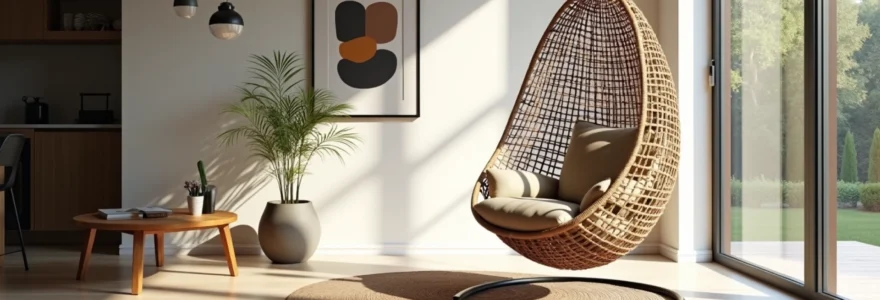
The evolution of furniture design has reached a remarkable intersection where comfort meets artistic expression, and nowhere is this more evident than in the world of suspended seating solutions. Hanging chairs have transcended their humble origins as simple swinging seats to become sophisticated pieces of functional art that challenge conventional notions of both ergonomic support and aesthetic appeal. These innovative seating solutions represent more than just a trend; they embody a fundamental shift in how designers approach the relationship between human comfort and spatial dynamics.
Modern hanging chairs demonstrate an unprecedented fusion of biomechanical engineering and cutting-edge design principles. From the iconic egg-shaped cocoons that cradle the human form to sleek geometric structures that appear to defy gravity, these pieces offer a unique proposition: furniture that moves with you rather than simply supporting you. The gentle, rhythmic motion inherent in suspended seating provides therapeutic benefits whilst simultaneously serving as a striking focal point in contemporary interiors.
The appeal of hanging chairs extends far beyond their visual impact. They represent a paradigm shift towards dynamic furniture design , where static support gives way to adaptive comfort systems that respond to the user’s movements and posture needs. This innovative approach has captured the attention of interior designers, ergonomic specialists, and wellness advocates alike, establishing hanging chairs as essential elements in the modern design vocabulary.
Ergonomic engineering behind suspended seating solutions
The science behind effective hanging chair design begins with a deep understanding of human biomechanics and the complex interplay between body weight distribution, spinal alignment, and muscular tension relief. Unlike traditional seating that relies on rigid support structures, suspended chairs utilise the principles of dynamic equilibrium to create a more natural and responsive seating experience.
Biomechanical pressure distribution in hanging chair mechanisms
The suspended nature of hanging chairs fundamentally alters how pressure is distributed across the human body during seated activities. Traditional chairs often create concentrated pressure points, particularly around the tailbone and upper thighs, which can lead to circulation issues and muscular tension over extended periods. Hanging chairs address this challenge through their unique pressure distribution matrix , which spreads body weight more evenly across a broader surface area.
Research in biomechanical engineering has demonstrated that hanging chairs can reduce peak pressure points by up to 40% compared to conventional seating. This reduction occurs because the chair’s suspension system allows for micro-movements that continuously redistribute weight, preventing the build-up of sustained pressure in any single area. The curved design of most hanging chairs naturally follows the body’s contours, creating what ergonomic specialists term “adaptive pressure mapping” .
Spinal alignment optimisation through dynamic support systems
One of the most significant ergonomic advantages of hanging chairs lies in their ability to promote natural spinal curvature whilst accommodating individual variations in posture and movement preferences. The gentle swaying motion inherent in suspended seating encourages subtle postural adjustments that help maintain the spine’s natural S-curve throughout extended sitting sessions.
The dynamic support provided by hanging chairs differs markedly from static ergonomic solutions. Rather than forcing the spine into a predetermined “correct” position, these chairs allow for natural movement patterns that engage core stabilising muscles and promote active sitting. This approach aligns with contemporary ergonomic philosophy, which emphasises movement and adaptability over rigid postural constraints.
Weight distribution algorithms in acapulco and bubble chair designs
Modern hanging chair manufacturers employ sophisticated weight distribution algorithms to optimise the placement of suspension points and determine optimal seat geometry. Acapulco-style chairs, with their distinctive woven cord construction, distribute weight through a network of intersecting support lines that create multiple load paths. This redundancy ensures that stress is never concentrated on a single structural element.
Bubble chairs, popularised by designers like Eero Aarnio, utilise a different approach to weight distribution through their enclosed spherical design. The suspension point is carefully calculated to maintain the chair’s centre of gravity whilst providing a stable yet mobile seating platform. These geometric considerations ensure that users experience optimal comfort regardless of their size or sitting preferences.
Lumbar support integration in eero aarnio’s ball chair variations
The integration of lumbar support in spherical hanging chair designs presents unique engineering challenges that require innovative solutions. Eero Aarnio’s Ball Chair variations demonstrate how effective lower back support can be achieved without compromising the chair’s aesthetic integrity or freedom of movement. The curved interior surface is precisely contoured to provide gentle lumbar pressure whilst maintaining the chair’s iconic silhouette.
Advanced Ball Chair variants incorporate adjustable lumbar support systems that allow users to customise their seating experience. These systems utilise memory foam inserts and adjustable tensioning mechanisms that can be fine-tuned to individual preferences. The result is a suspended seating solution that provides both the visual drama of a statement piece and the comfort requirements of extended use.
Material science innovations in contemporary hanging furniture
The development of advanced materials has revolutionised hanging chair construction, enabling designers to create pieces that are simultaneously lighter, stronger, and more durable than their predecessors. Modern hanging chairs benefit from decades of research in composite materials, synthetic fibres, and protective coatings that extend their lifespan whilst maintaining aesthetic appeal.
High-tensile synthetic rattan weaving techniques
Contemporary synthetic rattan represents a significant advancement over natural materials, offering superior durability, consistent quality, and enhanced weather resistance. High-tensile synthetic rattan fibres are engineered to withstand UV exposure, moisture, and temperature fluctuations whilst maintaining their structural integrity and visual appeal. These materials typically feature a tensile strength rating of 800-1200 PSI, significantly exceeding natural rattan’s capabilities.
Advanced weaving techniques utilise computer-controlled machinery to create consistent tension patterns that optimise both strength and flexibility. The resulting woven surfaces provide excellent support characteristics whilst allowing for the natural give and flex that makes hanging chairs so comfortable. Modern synthetic rattan weaving also enables the incorporation of colour-fast pigments that maintain their vibrancy for decades.
Powder-coated steel framework durability standards
The structural frameworks of premium hanging chairs increasingly rely on powder-coated steel components that undergo rigorous testing to meet international durability standards. Powder coating provides superior corrosion resistance compared to traditional paint finishes, with properly applied coatings offering protection for 15-20 years even in harsh outdoor environments.
The powder coating process involves electrostatically applying dry powder to steel surfaces before curing at high temperatures. This creates a finish that is four times thicker than conventional paint and significantly more resistant to chipping, scratching, and fading. Quality hanging chair manufacturers subject their powder-coated components to salt spray testing, UV exposure testing, and impact resistance testing to ensure long-term performance.
Uv-resistant polyethylene construction in kartell masters chairs
Kartell’s Masters Chair series exemplifies the potential of advanced polyethylene formulations in suspended seating applications. The proprietary polyethylene blend used in these designs incorporates UV stabilisers and impact modifiers that maintain structural integrity and colour stability even after years of sun exposure. This material innovation allows for the creation of hanging chairs that can transition seamlessly between indoor and outdoor environments.
The injection moulding process used for polyethylene hanging chairs enables complex geometric forms that would be impossible to achieve with traditional construction methods. The material’s inherent flexibility provides comfort without requiring additional cushioning, whilst its low density keeps overall weight to a minimum. These characteristics make polyethylene hanging chairs ideal for applications where frequent repositioning is required.
Memory foam cushioning technology integration
The integration of memory foam technology in hanging chair cushions represents a significant advancement in suspended seating comfort. Modern memory foam formulations respond to body temperature and weight distribution, creating a personalised seating surface that adapts to individual users. High-density memory foam retains its shape-conforming properties even in the dynamic environment of a swinging chair.
Advanced memory foam cushions for hanging chairs often incorporate dual-density configurations , with firmer foam providing structural support whilst softer surface layers offer immediate comfort. These cushions are typically encased in breathable, moisture-wicking covers that help regulate temperature and prevent the accumulation of condensation in enclosed chair designs.
Weather-resistant olefin fabric performance metrics
Olefin fabric has emerged as the material of choice for hanging chair cushions and upholstery in outdoor applications due to its exceptional resistance to moisture, mildew, and UV degradation. Solution-dyed olefin fibres maintain colour integrity even after prolonged sun exposure, with many formulations showing less than 5% colour fade after 1000 hours of UV testing.
The hydrophobic nature of olefin fibres means that water and other liquids bead on the surface rather than penetrating the fabric. This characteristic, combined with antimicrobial treatments, prevents the growth of mould and mildew that can plague other outdoor fabric options. Additionally, olefin’s inherent stain resistance eliminates the need for chemical treatments that can compromise fabric breathability and comfort.
Architectural integration principles for suspended seating
The successful integration of hanging chairs into architectural spaces requires careful consideration of structural requirements, spatial relationships, and aesthetic harmony. Modern architects and interior designers are increasingly incorporating suspended seating as integral elements of their designs rather than treating them as afterthought additions. This approach results in more cohesive and functionally effective interior environments.
Ceiling-mounted hanging chairs require robust structural support systems that must be carefully engineered to handle both static loads and dynamic forces generated by swinging motion. The installation typically involves securing mounting hardware to structural beams or reinforced ceiling areas capable of supporting at least three times the expected load. This safety margin accounts for dynamic loading and ensures long-term structural integrity.
The spatial requirements for hanging chairs extend beyond the chair’s physical dimensions to include adequate clearance for swinging motion and safe approach and exit paths. Designers must consider the full arc of movement when positioning hanging chairs , ensuring that users can enter and exit safely whilst maintaining appropriate clearances from walls, furniture, and other obstacles.
Acoustic considerations also play a crucial role in hanging chair integration, particularly in multi-story buildings where suspension hardware might transmit vibrations to adjacent spaces. Modern installation systems incorporate vibration-dampening materials and flexible mounting systems that isolate hanging chairs from the building structure, preventing noise transmission whilst maintaining safety and stability.
Lighting design for spaces featuring hanging chairs requires special attention to avoid creating harsh shadows or glare conditions that might compromise comfort and usability. Ambient lighting schemes that complement the dynamic nature of suspended seating often incorporate multiple light sources positioned to provide even illumination throughout the chair’s range of motion.
Designer collections defining modern hanging chair aesthetics
The contemporary hanging chair landscape has been profoundly shaped by visionary designers who have pushed the boundaries of both form and function. These influential collections have established design languages that continue to inspire manufacturers and consumers alike, creating a rich vocabulary of suspended seating solutions that span from minimalist modernist statements to elaborate postmodern expressions.
Arne jacobsen’s egg chair influence on contemporary designs
Arne Jacobsen’s iconic Egg Chair, though not originally designed as a hanging chair, has profoundly influenced the development of suspended seating aesthetics through its revolutionary approach to enveloping, cocoon-like comfort. The Egg Chair’s organic curves and high-backed design have been adapted and reinterpreted in countless hanging chair variations that seek to capture its sense of protective intimacy whilst adding the dynamic element of suspension.
Contemporary designers have drawn inspiration from Jacobsen’s use of moulded materials and his ability to create furniture that feels both futuristic and timeless. Modern hanging egg chairs often feature similar proportions and spatial relationships, but achieve their structural integrity through advanced composite materials and innovative suspension systems. The influence of Jacobsen’s work can be seen in the way contemporary hanging chairs prioritise the creation of personal, enclosed spaces within larger architectural environments.
Patricia urquiola’s tropicalia series design philosophy
Patricia Urquiola’s Tropicalia series represents a masterful synthesis of traditional craftsmanship and contemporary design sensibilities, particularly evident in her hanging chair interpretations. Urquiola’s approach emphasises the tactile qualities of materials and the visual rhythm created by woven surfaces, resulting in hanging chairs that feel both familiar and innovative.
The Tropicalia design philosophy embraces imperfection and handcrafted variation as essential elements of beauty, a approach that translates particularly well to hanging chair construction. The series demonstrates how traditional weaving techniques can be reimagined using modern materials to create seating solutions that are both structurally sophisticated and visually warm. Urquiola’s work has influenced a generation of designers to consider hanging chairs as expressions of cultural heritage reimagined for contemporary living.
Nanna ditzel’s hanging egg chair revolutionary impact
Nanna Ditzel’s original Hanging Egg Chair design fundamentally transformed perceptions of suspended seating from novelty item to serious design statement. Ditzel’s 1957 creation established many of the proportional relationships and comfort principles that continue to guide hanging chair design today. Her revolutionary approach involved creating a chair that was simultaneously sculptural object and intimate refuge.
The impact of Ditzel’s work extends beyond aesthetics to encompass functional innovations that addressed the unique challenges of suspended seating. Her attention to entry and exit ergonomics, the integration of cushioning systems, and the development of stable suspension mechanisms created a template that countless designers have referenced and refined. Ditzel’s legacy lies in proving that hanging chairs could be both practical everyday furniture and powerful design statements.
Rattan revival through modern scandinavian interpretations
The contemporary revival of rattan in hanging chair design owes much to Scandinavian designers who have reimagined traditional weaving techniques through a modernist lens. This revival movement has produced hanging chairs that celebrate the natural beauty of rattan whilst incorporating contemporary proportions and construction methods that ensure durability and comfort.
Modern Scandinavian rattan hanging chairs typically feature simplified forms that emphasise material purity and functional clarity. The designs often incorporate subtle colour variations and texture contrasts that add visual interest without compromising the material’s natural appeal. Sustainable harvesting practices and improved treatment processes have made contemporary rattan hanging chairs both environmentally responsible and exceptionally long-lasting.
Installation engineering and structural load requirements
The successful installation of hanging chairs requires a comprehensive understanding of structural engineering principles and building codes that govern ceiling-mounted fixtures. Professional installation ensures not only user safety but also protects against property damage that could result from inadequate mounting systems or improper load calculations.
Structural load calculations for hanging chairs must account for both static weight and dynamic forces generated by swinging motion. Engineers typically specify mounting systems capable of supporting a minimum of 500 pounds, even for chairs with lower user weight ratings. This generous safety margin accommodates the amplified forces created by dynamic loading and provides protection against material fatigue over time.
Modern hanging chair installation systems often incorporate load-distributing hardware that spreads mounting forces across multiple structural elements. These systems reduce stress concentrations and provide redundant load paths that maintain safety even if individual mounting points experience failure. Professional installers use specialised hardware including through-bolts, structural screws, and reinforcement plates designed specifically for suspended seating applications.
Building code compliance varies significantly by jurisdiction, but most areas classify hanging chairs as fixed furniture requiring engineered mounting systems. Some installations may require building permits, particularly in commercial applications or multi-story residential buildings. Professional installers maintain current knowledge of local codes and can navigate the permitting process to ensure compliant installations.
The long-term maintenance of hanging chair installation systems requires periodic inspection of mounting hardware, suspension components, and structural connections. Quality installation systems include access provisions that allow for routine maintenance without requiring complete removal of the chair or major structural modifications.
Psychological comfort factors in Cocoon-Style seating design
The psychological appeal of hanging chairs extends far beyond their physical comfort characteristics to encompass fundamental human needs for security, privacy, and sensory stimulation. Cocoon-style hanging chairs tap into primal comfort associations that make them particularly effective at promoting relaxation and stress relief in modern living environments.
Research in environmental psychology has demonstrated that enclosed seating arrangements create a sense of territorial ownership and personal control that can significantly reduce stress and anxiety levels. Hanging chairs amplify these benefits through their elevated position and mobility, which provide users with enhanced visual control over their environment whilst maintaining a sense of protected intimacy.
The gentle rocking motion inherent in hanging chairs activates the vestibular system in ways that promote relaxation and can help regulate circadian rhythms. This motion mimics the soothing movements experienced in early development, creating comfort associations that operate below the level of conscious awareness. The rhythmic nature of suspended seating can
improve circulation and trigger the release of endorphins, creating a natural pathway to improved mood and mental wellbeing.
The enclosed design of cocoon-style hanging chairs creates what psychologists refer to as a protective environment effect, where users experience reduced external stimuli whilst maintaining visual connection to their surroundings. This balance between shelter and awareness allows for deep relaxation without the anxiety that can accompany complete isolation. The elevated position of hanging chairs also satisfies the human preference for commanding views, a evolutionary trait that contributes to feelings of security and control.
Colour psychology plays a significant role in the comfort provided by hanging chair designs. Natural tones and earth colours commonly used in rattan and wicker constructions evoke associations with safety and stability, whilst the organic textures provide tactile comfort that synthetic materials often cannot match. The combination of visual, tactile, and vestibular stimulation creates a multi-sensory comfort experience that addresses both conscious and unconscious psychological needs.
The social psychology of hanging chairs reveals their effectiveness as conversation facilitators and relationship builders. The informal, relaxed positioning encouraged by suspended seating breaks down social barriers and promotes more open, authentic interactions. The gentle movement creates a shared experience that can help establish rapport and reduce tension in social situations, making hanging chairs particularly valuable in therapeutic and hospitality environments.
Personal space dynamics in hanging chair design acknowledge the human need for controllable territory within shared environments. Users can adjust their orientation, height, and movement patterns to create precisely the level of social engagement or privacy they desire at any given moment. This adaptability makes hanging chairs particularly effective in modern open-plan living and working environments where traditional privacy solutions may not be practical or aesthetically appropriate.
The temporal aspects of hanging chair comfort deserve special attention, as these seating solutions excel at facilitating the transition between active and restful states. The gradual deceleration of movement naturally cues the nervous system to shift from sympathetic to parasympathetic dominance, promoting the physiological changes associated with deep relaxation and stress recovery. This makes hanging chairs uniquely effective for meditation, reading, and other contemplative activities that benefit from a calm, centred mental state.