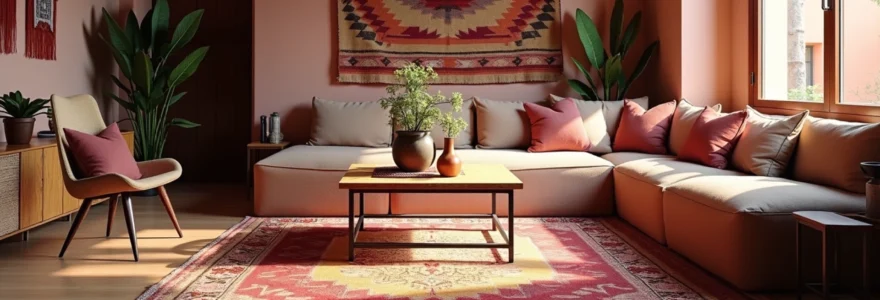
Moroccan textiles possess an extraordinary magnetism that has captivated designers, collectors, and homeowners worldwide for centuries. The intricate artistry, vibrant colours, and profound cultural heritage woven into each piece create textiles that transcend mere functional fabric to become works of living art. From the bustling souks of Marrakech to luxury fashion houses in Paris, these remarkable materials continue to influence contemporary design while maintaining their authentic traditional character. The appeal lies not merely in their visual beauty, but in the complex interplay of ancient techniques, symbolic meanings, and exceptional craftsmanship that characterises every thread.
The global fascination with Moroccan textiles stems from their unique ability to bridge historical tradition with modern aesthetic sensibilities. Each piece tells a story through its patterns, colours, and construction methods, carrying the wisdom of generations of skilled artisans who have perfected their craft over millennia. This cultural authenticity, combined with uncompromising quality standards and sustainable production methods, positions Moroccan textiles as both luxurious design elements and meaningful cultural artefacts in today’s conscious consumption landscape.
Ancient berber weaving techniques and artisanal craftsmanship
The foundation of Moroccan textile excellence rests upon ancient Berber weaving traditions that have remained virtually unchanged for over 2,000 years. These time-honoured techniques represent more than mere craft skills; they embody a profound understanding of materials, symbolism, and cultural expression that distinguishes authentic Moroccan textiles from mass-produced imitations. The mastery required to execute these traditional methods demands years of apprenticeship and an intuitive understanding of how different fibres behave under various tensions and conditions.
The complexity of Berber weaving extends far beyond the mechanical process of interlacing threads. Artisans must possess an intimate knowledge of seasonal variations in fibre quality, natural dye chemistry, and the symbolic significance of various patterns within their cultural context. This multifaceted expertise ensures that each textile carries both technical excellence and cultural authenticity, creating pieces that resonate with contemporary audiences seeking meaningful design elements.
Kilim Flat-Weave construction methods in atlas mountain communities
Within the Atlas Mountain communities, kilim flat-weave construction represents one of Morocco’s most sophisticated textile traditions. Unlike pile carpets, kilims employ a flat-weave technique where weft threads completely cover the warp, creating reversible textiles with identical patterns on both sides. This construction method requires exceptional precision, as any irregularity in tension or spacing becomes immediately apparent in the finished piece.
The geometric precision achieved in Atlas Mountain kilims reflects generations of mathematical understanding applied to textile construction. Weavers calculate complex pattern sequences mentally, maintaining perfect symmetry across large pieces without written guides or templates. This remarkable skill demonstrates the sophisticated mathematical concepts embedded within traditional Moroccan textile production, challenging Western assumptions about indigenous craft knowledge.
Traditional loom systems: vertical heddle and ground loom applications
Moroccan textile production employs two primary loom systems, each optimised for specific textile types and weaving requirements. Vertical heddle looms, predominantly used for carpet production, allow weavers to create complex pile structures with precise knot placement. The vertical orientation provides better tension control for heavier materials and enables the production of larger textiles without compromising structural integrity.
Ground looms, traditionally used for kilim and lighter textile production, demonstrate the adaptability of Moroccan weaving technology. These horizontal systems can be easily transported and set up in various locations, allowing nomadic communities to maintain their textile traditions while following seasonal migration patterns. The portability of ground looms contributed significantly to the spread and preservation of Berber weaving techniques across North Africa.
Natural dye extraction from saffron, henna, and madder root
The vibrant colours that characterise Moroccan textiles derive from sophisticated natural dye extraction processes refined over centuries. Saffron, harvested from Crocus sativus flowers, provides the brilliant yellows and oranges that illuminate many traditional pieces. The labour-intensive harvesting process, requiring over 150 flowers to produce just one gram of saffron, reflects the precious nature of these natural colourants and explains their traditional association with luxury textiles.
Henna and madder root contribute the rich reds and burgundies that feature prominently in Moroccan colour palettes. The extraction process involves complex mordanting techniques using natural minerals like alum and iron to achieve permanent colour fastness. These traditional dye methods not only produce colours of exceptional depth and luminosity but also ensure that textiles age gracefully, developing increasingly rich patinas over time.
Symbolic motif integration: diamond patterns and protective talismans
The patterns woven into Moroccan textiles carry profound symbolic meanings that connect users to cultural traditions and spiritual beliefs. Diamond patterns, ubiquitous in Berber weaving, represent the eye and serve as protective talismans against negative influences. These geometric forms also symbolise femininity and fertility, making them particularly significant in textiles used for ceremonial occasions and domestic spaces.
Protective talismans integrated into textile designs demonstrate the sophisticated understanding of symbolic communication within Berber culture. Chevron patterns invoke protection during travel, while hand motifs ward off evil influences. This symbolic vocabulary transforms functional textiles into powerful cultural artefacts that provide both practical utility and spiritual protection for their users.
Distinctive fibre composition and textile quality standards
The exceptional quality of Moroccan textiles stems from careful selection and processing of indigenous fibres, each chosen for specific properties that contribute to the final product’s performance and longevity. Moroccan artisans have developed sophisticated understanding of how different fibres interact within textile structures, enabling them to create pieces that optimise durability, comfort, and aesthetic appeal. This expertise in fibre selection and blending represents centuries of empirical knowledge about material properties and their optimal applications.
Quality standards in traditional Moroccan textile production focus on natural characteristics rather than industrial uniformity. Artisans value the subtle variations in colour and texture that occur naturally in hand-processed fibres, viewing these irregularities as marks of authenticity rather than defects. This approach to quality emphasises the unique character of handmade textiles while maintaining rigorous standards for structural integrity and longevity.
Beni ourain sheep wool: lanolin content and pile density analysis
Beni Ourain sheep, indigenous to Morocco’s Middle Atlas Mountains, produce wool with exceptional lanolin content that provides natural water resistance and antimicrobial properties. The high lanolin concentration, typically ranging from 12-18% compared to 3-5% in commercial wool breeds, creates textiles with inherent stain resistance and easy maintenance characteristics. This natural protection system eliminates the need for chemical treatments while providing superior performance in demanding environments.
Pile density in Beni Ourain carpets averages 40-60 knots per square inch, significantly higher than many commercial alternatives. This density, combined with the wool’s natural elasticity, creates textiles that maintain their appearance and structural integrity for decades. The mathematical precision required to achieve consistent pile density demonstrates the sophisticated technical knowledge embedded within traditional Moroccan carpet production.
Cactus silk production from sabra plant fibres
Sabra silk , extracted from the Aloe Vera cactus ( Agave americana ), represents Morocco’s most innovative sustainable textile fibre. The extraction process involves careful harvesting of mature cactus leaves, followed by a complex retting process that separates the silk-like fibres from the plant matter. These fibres exhibit remarkable tensile strength and natural lustre, creating textiles that rival traditional silk in appearance while offering superior durability.
The environmental benefits of cactus silk production make it increasingly relevant in today’s sustainability-conscious market. Agave plants require minimal water and actually improve soil conditions through their deep root systems, making them ideal for arid climate cultivation. A single mature plant can produce approximately 200-300 grams of usable fibre, providing sustainable income for rural communities while preserving traditional extraction techniques.
Cotton cultivation in souss valley: thread count and weave specifications
The Souss Valley’s unique microclimate produces cotton with exceptional staple length and consistency, creating fibres ideal for fine textile production. Thread counts in traditional Moroccan cotton textiles range from 200-400 threads per square inch, significantly higher than standard commercial products. This high thread count, achieved through careful selection of long-staple cotton and precise spinning techniques, results in textiles with exceptional smoothness and durability.
Weave specifications for Souss Valley cotton emphasise balanced thread distribution and consistent tension control. Traditional looms enable weavers to maintain optimal thread spacing while accommodating the natural variations in hand-spun cotton. This attention to weave structure creates textiles that drape beautifully while maintaining dimensional stability through repeated washing and use.
Camel hair integration in saharan desert textiles
Camel hair incorporation in Saharan textiles demonstrates the sophisticated understanding of fibre properties within traditional Moroccan production. The soft undercoat, collected during natural shedding periods, provides exceptional insulation properties while maintaining lightweight characteristics. These fibres exhibit natural temperature regulation, keeping users cool in extreme heat while providing warmth during desert nights.
The blending ratios of camel hair with other fibres require precise calculation to optimise textile performance. Traditional formulations combine 30-40% camel hair with locally sourced wool or cotton, creating textiles that balance the superior qualities of each fibre type. This blending expertise enables artisans to produce textiles specifically adapted to extreme climate conditions while maintaining the aesthetic qualities valued in luxury markets.
Regional textile specialisations across moroccan provinces
Morocco’s diverse geographical regions have developed distinct textile specialisations that reflect local resources, cultural influences, and climatic requirements. These regional variations create a rich tapestry of textile traditions, each contributing unique techniques and aesthetic approaches to the broader Moroccan textile heritage. The specialisation patterns demonstrate how traditional craft knowledge adapts to local conditions while maintaining cultural continuity across generations.
Understanding regional specialisations provides insight into the complexity and diversity of Moroccan textile production. Each province has developed specific techniques optimised for local materials and market demands, creating distinctive styles that are immediately recognisable to expert collectors and designers. This regional diversity ensures that Moroccan textiles offer unprecedented variety while maintaining consistent quality standards across different production centres.
Fez embroidery: tadla stitch techniques and geometric precision
Fez embroidery represents the pinnacle of Moroccan decorative textile arts, employing tadla stitch techniques that create intricate geometric patterns with mathematical precision. The tadla stitch, characterised by its counted-thread methodology, enables embroiderers to achieve perfect symmetry and consistent pattern spacing across large textile surfaces. This technique requires exceptional skill and patience, as each stitch must be placed with millimetre accuracy to maintain the overall design integrity.
The geometric precision achieved in Fez embroidery reflects the city’s historical role as a centre of Islamic learning and mathematics. Embroiderers apply complex geometric principles to create patterns that appear to extend infinitely, embodying mathematical concepts of tessellation and symmetry. These sophisticated design principles demonstrate the advanced mathematical knowledge integrated into traditional Moroccan craft practices.
Tetouan silk weaving: andalusian influence on pattern development
Tetouan’s silk weaving tradition bears the distinctive influence of Andalusian refugees who brought sophisticated pattern development techniques from Islamic Spain. The characteristic mudéjar patterns employed in Tetouan textiles combine geometric and stylised floral motifs in arrangements that reflect the refined aesthetic sensibilities of Al-Andalus. These pattern development methods create textiles with exceptional visual complexity while maintaining harmonious colour relationships.
The Andalusian influence on Tetouan silk weaving introduced advanced pattern scaling techniques that enable designs to be enlarged or reduced while maintaining their proportional relationships. This mathematical approach to pattern development allows weavers to adapt traditional designs for different textile sizes and applications without compromising their aesthetic integrity. The precision required for this pattern scaling demonstrates the sophisticated design knowledge preserved within Tetouan’s weaving community.
Middle atlas carpet production: zemmour and zayan tribal variations
The Zemmour and Zayan tribes of the Middle Atlas have developed distinct carpet production techniques that reflect their unique cultural identities and environmental adaptations. Zemmour carpets typically feature dense pile construction with bold geometric patterns in earthy colour palettes that reflect the mountainous landscape. The tribe’s traditional nomadic lifestyle influenced their preference for durable, portable textiles that could withstand frequent relocation.
Zayan tribal variations emphasise different structural approaches, often incorporating mixed-pile techniques that create textural variation within single pieces. Their traditional settlement patterns in fertile valleys provided access to diverse wool qualities, enabling more complex colour work and pattern development. These tribal variations demonstrate how social organisation and environmental factors influence textile development within closely related cultural groups.
Anti-atlas flatweave characteristics: ouaouzguite and taznakht styles
The Anti-Atlas region produces distinctive flatweave textiles that showcase two primary stylistic approaches: Ouaouzguite and Taznakht variations. Ouaouzguite weavers specialise in complex geometric patterns executed in vibrant colour combinations, often incorporating metallic threads to create lustrous surface effects. Their technical expertise enables them to produce textiles with exceptional pattern density while maintaining structural stability.
Taznakht style flatweaves emphasise different aesthetic principles, focusing on bold, simplified patterns in high-contrast colour combinations. The town’s position on historic trade routes influenced their access to diverse materials and design influences, creating a distinctive synthesis of Berber tradition and international aesthetic elements. These regional variations demonstrate the dynamic nature of traditional textile production and its responsiveness to cultural exchange.
Contemporary fashion integration and luxury brand collaborations
The integration of Moroccan textiles into contemporary fashion represents a significant evolution in global luxury markets, with prestigious fashion houses increasingly recognising the exceptional quality and cultural authenticity these materials provide. Leading designers have discovered that Moroccan textiles offer unique textures, colours, and construction qualities that cannot be replicated through industrial production methods. This recognition has elevated traditional Moroccan textile production from regional craft to globally significant luxury industry, creating new market opportunities while preserving traditional techniques.
Luxury brand collaborations with Moroccan artisans have established new paradigms for cultural exchange within the fashion industry. These partnerships typically emphasise fair trade principles and cultural preservation, ensuring that traditional knowledge holders receive appropriate recognition and compensation for their expertise. The resulting products combine centuries-old craftsmanship with contemporary design sensibilities, creating textiles that appeal to discerning consumers seeking authentic luxury experiences.
The most successful fashion collaborations respect traditional techniques while allowing for creative interpretation that meets contemporary market demands.
Contemporary fashion applications of Moroccan textiles extend far beyond simple pattern inspiration to encompass complete adoption of traditional construction methods and material specifications. High-end fashion houses have invested in understanding the technical aspects of traditional production, including natural dye formulations, weave structures, and finishing techniques. This deep engagement with traditional methods ensures that contemporary applications maintain the authentic qualities that distinguish Moroccan textiles from mass-produced alternatives.
Interior design applications and global market positioning
Moroccan textiles have achieved unprecedented prominence in global interior design markets, with luxury hotels, residential projects, and commercial spaces increasingly incorporating authentic pieces as focal design elements. The appeal stems from their ability to create sophisticated, culturally rich environments that transcend typical decorative approaches. Interior designers value Moroccan textiles for their versatility, durability, and capacity to establish distinctive aesthetic identities within diverse architectural contexts. The global market positioning of these textiles has evolved from exotic curiosities to essential luxury design elements valued by the most discerning clientele.
The integration of Moroccan textiles into contemporary interior design requires sophisticated understanding of their cultural contexts and appropriate applications. Successful implementations respect the traditional meanings and functions of different textile types while adapting them for modern living requirements. This approach ensures that interior design applications maintain cultural authenticity while meeting contemporary performance and aesthetic standards.
Market positioning strategies for Moroccan textiles emphasise their artisanal origins, sustainable production methods, and cultural significance as key differentiating factors. Premium pricing reflects not only the exceptional quality and labour intensity of traditional production but also the cultural heritage and artistic value embedded within each piece. This positioning approach has successfully established Moroccan textiles as luxury goods rather than mere decorative accessories, creating sustainable market demand that supports traditional production communities.
The global expansion of Moroccan textile markets has created new challenges and opportunities for traditional producers. Increased international demand necessitates scaling production while maintaining quality standards and cultural authenticity. Many cooperatives have developed sophisticated supply chain management systems that ensure consistent quality delivery while preserving traditional production methods. These organisational innovations demonstrate the adaptability of traditional craft communities to contemporary market requirements.
Sustainable production methods and fair trade certification standards
The commitment to sustainable production methods represents a fundamental aspect of traditional Moroccan textile manufacturing, with many communities maintaining practices that have minimal environmental impact while supporting local economies. Natural fibre processing techniques eliminate the need for synthetic chemicals, utilising locally sourced materials that biodegrade completely without environmental contamination. These traditional methods demonstrate remarkable efficiency, maximising resource utilisation while minimising waste generation through integrated production cycles that repurpose all organic materials.
Fair trade certification standards for Moroccan textiles have evolved to recognise the unique characteristics of traditional production methods while ensuring that artisans receive equitable compensation for their skills and labour. Certification bodies evaluate not only working conditions and wage structures but also the preservation of traditional knowledge and cultural practices. This comprehensive approach ensures that modernisation efforts enhance rather than compromise the cultural heritage embedded within traditional textile production.
Contemporary sustainable production initiatives focus on scaling traditional methods without compromising their environmental benefits or cultural authenticity. Solar energy integration for heating dye baths and yarn processing reduces dependence on fossil fuels while maintaining traditional temperature control methods. Water conservation systems capture and reuse processing water through natural filtration methods that have been refined over generations, demonstrating how traditional knowledge can inform modern sustainability practices.
The certification process for authentic Moroccan textiles involves rigorous documentation of production methods, material sources, and artisan compensation structures. Independent auditors verify that traditional techniques are maintained throughout production while ensuring that workers receive fair wages and safe working conditions. This certification system protects both consumers seeking authentic products and artisans maintaining traditional practices against exploitation by commercial interests seeking to capitalise on Morocco’s textile reputation without supporting traditional communities.
Sustainable production in Moroccan textiles means preserving both environmental resources and cultural knowledge for future generations while creating viable economic opportunities for traditional communities.
The integration of modern quality control systems with traditional production methods has created hybrid approaches that maintain artisanal authenticity while meeting international market standards. Digital documentation systems record traditional pattern knowledge and construction techniques, ensuring their preservation while facilitating knowledge transfer to new generations of artisans. These technological integrations respect traditional hierarchies and learning methods while providing tools that enhance rather than replace traditional expertise.
Supply chain transparency initiatives enable consumers to trace their textile purchases back to specific artisan communities, creating direct relationships between producers and end users. This transparency builds trust while educating consumers about the true value of traditional production methods and the skill required to create authentic Moroccan textiles. The resulting market awareness supports premium pricing structures that reflect the actual costs of sustainable, traditional production while discouraging low-quality imitations that undermine traditional communities.
Cooperative organisation structures provide framework for implementing fair trade principles while maintaining traditional production methods and community relationships. These cooperatives typically operate as democratic organisations where artisans share decision-making responsibilities and profit distribution according to traditional principles adapted for contemporary market requirements. The cooperative model enables small-scale producers to access international markets while maintaining control over their production processes and cultural practices.
Environmental monitoring systems track the ecological impact of traditional textile production, documenting water usage, energy consumption, and waste generation patterns. These monitoring efforts demonstrate that traditional methods consistently outperform industrial alternatives in environmental sustainability metrics while producing superior quality textiles. The data supports policy initiatives that protect traditional production areas from industrial development while promoting sustainable tourism and cultural preservation programs.
Training programs for new artisans combine traditional apprenticeship methods with contemporary business skills, ensuring that young people can build sustainable careers within traditional textile production. These programs emphasise cultural preservation alongside practical skills development, creating pathways for cultural continuity while adapting to changing economic conditions. The integration of traditional knowledge with modern business practices enables artisan communities to thrive in global markets while maintaining their cultural identity and production methods.
The global significance of Moroccan textiles extends far beyond their immediate economic impact to encompass their role as repositories of cultural knowledge and sustainable production techniques. As contemporary society grapples with environmental challenges and seeks authentic alternatives to mass production, Moroccan textile traditions offer proven models for sustainable manufacturing that creates meaningful employment while preserving cultural heritage. These textiles continue to captivate global markets not merely for their aesthetic appeal but for their embodiment of principles that increasingly define responsible luxury consumption in the 21st century.