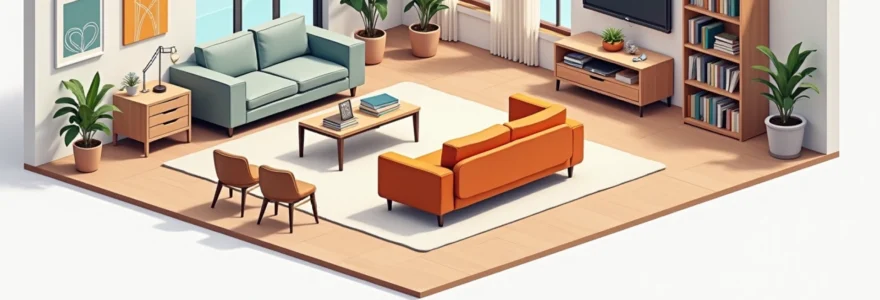
Transforming your living space from chaotic to harmonious requires more than simply placing furniture where it fits. The strategic arrangement of furnishings fundamentally impacts how you move through your home, how comfortable you feel in each room, and even how productive you can be in your daily activities. When done correctly, thoughtful furniture placement creates an invisible choreography that guides movement while maximising both functionality and aesthetic appeal.
Modern interior design principles recognise that spatial flow directly influences our psychological well-being and physical comfort. Research from environmental psychology studies indicates that well-planned room layouts can reduce stress levels by up to 23% whilst improving task efficiency by nearly 15%. This substantial impact stems from our innate need for logical, unobstructed pathways and comfortable interaction zones within our personal spaces.
The art of furniture arrangement extends beyond mere decoration—it’s about creating environments that support your lifestyle whilst respecting the architectural integrity of your space. Whether you’re dealing with a compact studio apartment or an expansive open-plan home, understanding the fundamental principles of spatial planning will revolutionise how you experience your living environment.
Spatial planning fundamentals for optimal room flow
Effective spatial planning begins with understanding your room’s natural architecture and traffic patterns. Every space possesses an inherent flow that can be enhanced or hindered by furniture placement. Professional designers typically start by identifying what interior architects call the “desire lines”—the natural paths people instinctively take when moving through a room. These pathways form the skeleton around which all other design decisions revolve.
The concept of circulation space proves crucial in creating comfortable room flow. Industry standards recommend maintaining minimum clearances of 36 inches for primary walkways and 24 inches for secondary passages. However, these measurements represent bare minimums; optimal comfort often requires additional space. Consider how furniture placement affects both physical movement and visual sightlines throughout your room.
Traffic pattern analysis and movement corridors
Analysing traffic patterns requires observing how family members naturally move through spaces during different times of day. Morning routines typically involve linear movements from bedroom to kitchen to exit points, whilst evening patterns tend to be more circular, focusing on relaxation zones. Understanding these rhythms helps identify where furniture should facilitate movement rather than obstruct it.
Primary corridors should remain completely unobstructed, while secondary pathways can accommodate occasional furniture pieces like side tables or floor lamps. The key lies in ensuring that no pathway forces awkward navigation around furniture legs or requires sideways movement through narrow gaps. Professional space planners often use the “wheelchair test”—if a wheelchair cannot navigate the space comfortably, the layout needs adjustment.
Feng shui bagua map application for energy flow
The ancient Chinese practice of Feng Shui offers valuable insights into spatial energy flow that complement modern design principles. The Bagua map divides any room into nine areas, each corresponding to different life aspects such as wealth, health, and relationships. While you needn’t embrace the spiritual elements, the underlying principles of chi flow align remarkably well with contemporary traffic pattern optimisation.
According to Feng Shui principles, furniture should never block the main entrance or create sharp corners pointing toward seating areas. This translates practically into avoiding furniture arrangements that create visual or physical barriers near doorways. The practice also emphasises the importance of curved pathways over straight lines, which modern ergonomic research supports for reducing movement strain.
Golden ratio proportions in furniture placement
The Golden Ratio (approximately 1.618:1) appears throughout nature and has been utilised in architecture and design for millennia. When applied to furniture arrangement, this mathematical principle helps create visually pleasing proportions that feel naturally comfortable. For instance, when positioning a sofa and coffee table, the space between them should ideally measure about 18 inches, while the coffee table length should be approximately two-thirds the sofa’s length.
This proportional approach extends to room divisions and furniture groupings. If you’re creating multiple seating areas in a large room, the smaller conversation area should occupy roughly 38% of the total space, leaving 62% for the primary seating arrangement. These ratios create subconscious visual harmony that makes spaces feel more balanced and inviting.
Anthropometric data for clearance requirements
Anthropometric data—measurements based on human body dimensions—provides the scientific foundation for comfortable furniture spacing. The average person requires 22-24 inches of knee clearance when seated, 30 inches of width for comfortable seating, and 36 inches of clearance to walk comfortably behind seated individuals. These measurements inform everything from dining table placement to living room seating arrangements.
Consider that comfortable conversation occurs when speakers are positioned 4-8 feet apart, while intimate discussions require 3-4 feet of separation. Television viewing demands specific distances based on screen size: 55-inch screens require 7-9 feet of viewing distance, while 75-inch screens need 9-12 feet. Incorporating these anthropometric principles ensures your furniture arrangement supports natural human behaviour rather than fighting against it.
Ergonomic furniture positioning for enhanced comfort
Ergonomic principles extend far beyond office environments, playing a crucial role in every room of your home. The science of human factors engineering demonstrates that proper furniture positioning can prevent physical strain, improve posture, and enhance overall comfort during daily activities. This approach considers not just static positioning but also the dynamic movements required for various tasks throughout your space.
Research from occupational health studies reveals that poor furniture arrangement contributes to musculoskeletal problems in up to 34% of home-based workers. However, these issues aren’t limited to work environments—improper seating heights, inadequate lighting positioning, and poorly placed surfaces affect comfort during leisure activities as well. Understanding ergonomic principles helps create spaces that support your body’s natural mechanics.
Herman miller aeron chair height and lumbar support calibration
The Herman Miller Aeron chair, considered the gold standard in ergonomic seating, offers valuable lessons applicable to any seating arrangement. Proper chair height places feet flat on the floor with thighs parallel to the ground, while the seat depth allows 2-3 inches between the chair edge and your knees. The armrests should support your arms at a 90-degree angle when typing or writing.
Even if you don’t own an Aeron chair, these principles apply to any seating. Dining chairs should position diners with their elbows at table height, while lounge chairs should support the natural curve of your spine. Consider adding lumbar cushions or adjusting chair positioning to achieve proper support. The investment in ergonomic positioning pays dividends in reduced fatigue and improved comfort during extended sitting periods.
Steelcase Height-Adjustable desk positioning protocols
Height-adjustable desks have revolutionised home workspace ergonomics, but proper positioning protocols extend beyond simple height adjustment. Standing desk positioning requires your monitor top to align with eye level, elbows to maintain 90-degree angles, and feet to rest flat on an anti-fatigue mat. Transitioning between sitting and standing positions should occur every 30-45 minutes for optimal health benefits.
The desk surface should position 1-2 inches below elbow height when seated, allowing your shoulders to remain relaxed while typing. If your desk lacks height adjustment, consider adjustable keyboard trays or monitor arms to achieve proper positioning. The goal is creating a workspace that accommodates your body’s needs rather than forcing adaptation to fixed furniture heights.
Scandinavian hygge seating arrangements for relaxation
The Danish concept of hygge emphasises comfort, cosiness, and contentment through thoughtful environmental design. Scandinavian seating arrangements typically feature lower furniture profiles, soft textures, and intimate groupings that encourage relaxation and conversation. This approach prioritises psychological comfort alongside physical ergonomics.
Hygge-inspired arrangements often include multiple seating options at varying heights—floor cushions, low stools, and traditional chairs—allowing people to choose their preferred relaxation position. Soft lighting, warm textiles, and natural materials complement these arrangements, creating environments that promote stress reduction and emotional well-being. The key lies in creating spaces that feel like gentle embraces rather than formal presentations.
Television viewing distance calculations based on screen size
Proper television positioning protects eye health while maximising viewing pleasure. The Society of Motion Picture and Television Engineers recommends viewing distances of 1.5-2.5 times the screen’s diagonal measurement for optimal comfort. This translates to 6-10 feet for 55-inch screens and 8-13 feet for 65-inch displays. Screen centre should align with eye level when seated in your primary viewing position.
Consider viewing angles when arranging seating around televisions. The optimal viewing angle spans 30 degrees on either side of the screen centre, meaning seating should form a gentle arc rather than extending too far to the sides. Ambient lighting should eliminate screen glare while providing enough illumination to prevent eye strain during extended viewing sessions.
Task lighting integration with west elm and IKEA pieces
Task lighting integration requires coordinating light sources with furniture placement to eliminate shadows and provide adequate illumination for specific activities. Reading chairs need adjustable side lighting positioned over the shoulder, while dining areas benefit from pendant lights centred above tables. The key lies in layering different light types—ambient, task, and accent—throughout your furniture arrangement.
Popular retailers like West Elm and IKEA offer numerous lighting solutions designed to complement various furniture arrangements. Floor lamps should provide light without creating glare on television screens, while table lamps need adequate surface space and nearby electrical outlets. Consider how lighting placement affects both functionality and ambience when planning your furniture layout.
Living room focal point configuration strategies
Every successful living room arrangement begins with identifying and enhancing a natural focal point. This central element anchors the entire space while providing visual direction for furniture placement. Traditional focal points include fireplaces, large windows with scenic views, or prominent architectural features. However, modern homes often require creating artificial focal points through strategic furniture grouping or art placement.
The most effective focal points possess both visual weight and functional purpose. A fireplace naturally draws attention while providing warmth and ambience, making it an ideal anchor for seating arrangements. Similarly, a large piece of artwork or an entertainment centre can serve as a focal point whilst supporting daily activities. The key lies in ensuring your chosen focal point doesn’t compete with other elements for attention.
Once established, your focal point should influence the placement of your largest furniture pieces. The primary seating—typically a sofa—should face or angle toward the focal point at a comfortable viewing distance. Secondary seating can then be arranged to complement this primary relationship whilst maintaining good sight lines and conversation flow. This hierarchical approach creates visual harmony and functional clarity throughout the space.
Consider that focal point strength varies based on size, contrast, and positioning within the room. A small painting on a large wall may lack sufficient visual weight to anchor furniture arrangements, whilst an oversized piece might overwhelm the space. Balance is crucial—your focal point should command attention without dominating the entire room. Professional designers often use the rule of thirds, positioning focal points approximately one-third of the way along major walls rather than centring them precisely.
Professional interior designers consistently emphasise that the strongest focal points combine visual appeal with functional purpose, creating anchors that support both aesthetic goals and daily living requirements.
Open-plan space zoning through strategic furniture placement
Open-plan living presents unique challenges and opportunities for furniture arrangement. Without walls to define separate areas, strategic furniture placement becomes the primary tool for creating distinct zones within a continuous space. This approach, known as space planning through furniture , requires careful consideration of sight lines, traffic flow, and functional relationships between different areas.
Successful open-plan arrangements typically feature three to four distinct zones, each serving specific functions while maintaining visual connectivity to the overall space. Common zones include cooking/dining, relaxation, work/study, and entrance/transition areas. The key lies in creating subtle boundaries that define each zone without fragmenting the space’s open feel. Furniture acts as both functional elements and spatial dividers in these arrangements.
Scale plays a crucial role in open-plan furniture selection and placement. Oversized pieces can overwhelm the space, whilst undersized furniture may appear lost in the expanse. The goal is achieving visual balance through varied heights, textures, and forms whilst maintaining clear circulation paths between zones. Professional space planners often use the “floating island” concept, positioning furniture groupings away from walls to create defined areas within the larger space.
Room divider solutions using bookshelves and consoles
Bookshelves and console tables offer excellent solutions for creating subtle room divisions without blocking light or air circulation. Open bookcases positioned perpendicular to walls can separate living and dining areas while maintaining visual connection between spaces. The key lies in choosing pieces with appropriate proportions—too tall, and they create visual barriers; too low, and they fail to define separate zones effectively.
Console tables work particularly well for creating entrance zones or separating conversation areas from dining spaces. Position them strategically to guide traffic flow whilst providing surface space for decorative objects or practical items. The height should complement surrounding furniture while creating a clear visual boundary between functional areas. Consider adding table lamps or tall plants to enhance the dividing effect without creating solid barriers.
Rug demarcation techniques for activity areas
Area rugs provide one of the most effective and flexible methods for defining separate zones within open-plan spaces. Different rug patterns, textures, and sizes can clearly delineate functional areas while adding colour and comfort to hard flooring surfaces. The traditional approach involves placing rugs completely under furniture groupings, but modern arrangements often feature rugs that extend partially under key pieces.
Rug sizing proves critical for effective zone definition. Living room rugs should accommodate all seating with front legs on the rug surface, while dining area rugs need sufficient space for chairs when pulled out from the table. Consider leaving 18-24 inches of bare floor around rug edges to create visual breathing room and prevent the space from feeling cramped or cluttered.
Modular sectional arrangements for flexible layouts
Modular sectional furniture offers unparalleled flexibility for open-plan arrangements, allowing you to reconfigure seating based on changing needs or occasions. These systems typically include various components—armless chairs, corner units, ottomans—that can be arranged in multiple configurations. The adaptability makes them ideal for spaces that serve multiple functions or accommodate varying group sizes.
When arranging modular sectionals, consider both current needs and future flexibility. L-shaped configurations work well for creating conversation areas while defining space boundaries. U-shaped arrangements accommodate larger groups but require substantial floor space. The beauty lies in the ability to reconfigure pieces seasonally or for special occasions, making these systems particularly valuable in modern dynamic living situations.
Small space maximisation through Multi-Functional furniture
Small space living demands creative approaches to furniture selection and arrangement that maximise functionality without sacrificing comfort or style. The key lies in choosing pieces that serve multiple purposes while maintaining the visual spaciousness of compact areas. This strategy, known as space multiplication , can effectively double or triple the functional capacity of limited square footage through intelligent design choices.
Multi-functional furniture has evolved significantly from basic fold-out options to sophisticated systems that seamlessly integrate multiple capabilities. Modern designs prioritise aesthetics alongside functionality, ensuring that space-saving solutions don’t compromise visual appeal. Research from urban living studies indicates that well-planned small spaces can provide comfort levels comparable to areas 30-40% larger through strategic furniture choices and arrangement.
The psychology of small space living reveals that visual tricks play as important a role as actual functionality. Furniture that appears to float—such as wall-mounted pieces or items with exposed legs—creates the illusion of more floor space. Similarly, transparent or reflective surfaces help spaces feel larger whilst maintaining their practical functions. Understanding these perceptual principles guides effective small space furniture strategies.
Ottoman storage solutions and nesting tables implementation
Storage ottomans represent perfect examples of multi-functional design, providing seating, footrests, coffee tables, and hidden storage within a single piece. When selecting storage ottomans, consider both the storage capacity and the surface durability for various uses. Leather or sturdy fabric tops can accommodate drinks and books, whilst soft tops work better for pure seating or footrest functions.
Nesting tables offer exceptional flexibility in small spaces, providing surface area when needed whilst disappearing completely when not in use. The largest table can serve as a permanent side table, whilst smaller pieces emerge for entertaining or specific tasks. Consider nesting sets with complementary heights—the smallest should slide completely under seating, whilst the largest should align with arm heights for convenient use.
Wall-mounted folding desk systems for compact living
Wall-mounted folding desks revolutionise small space work areas by providing full
functionality when needed whilst virtually disappearing when not in use. These systems typically feature robust mounting hardware capable of supporting 50-100 pounds, allowing them to accommodate laptops, books, and office supplies without compromising structural integrity. The folding mechanism should operate smoothly through hundreds of cycles whilst maintaining precise alignment when deployed.
Modern wall-mounted desk systems often incorporate cable management solutions and integrated lighting, creating complete workstations that fold flat against walls when not needed. Consider positioning these desks near windows for natural light whilst ensuring adequate wall space for the fully extended surface. The ideal height places the work surface 28-30 inches from the floor, accommodating standard office chairs whilst providing comfortable typing positions.
Murphy bed integration in studio apartments
Murphy beds represent the ultimate space-saving solution for studio apartments, effectively transforming sleeping areas into living spaces during daytime hours. Modern Murphy bed systems integrate seamlessly with surrounding furniture, often incorporating desks, shelving, or entertainment centres within the same unit. Quality mechanisms ensure smooth operation whilst maintaining mattress comfort comparable to traditional beds.
Installation requires careful consideration of ceiling height, floor clearance, and surrounding furniture placement. The bed should clear all obstacles when lowering, whilst the folded position must not interfere with daily activities. Consider soft-close mechanisms that prevent rapid deployment, protecting both users and nearby objects. Many contemporary designs feature integrated lighting and USB charging ports, maintaining functionality in both configurations.
Vertical storage utilisation with floor-to-ceiling units
Floor-to-ceiling storage units maximise vertical space whilst creating dramatic visual impact in small rooms. These systems work particularly well in rooms with high ceilings, drawing the eye upward and creating the illusion of expanded space. The key lies in balancing storage capacity with visual weight—too much solid mass can make spaces feel oppressive rather than organised.
Consider incorporating open shelving alongside closed storage to prevent walls from appearing too heavy or imposing. The most frequently accessed items should occupy the middle sections, whilst seasonal or rarely used objects can be stored in higher compartments. Integrated lighting within these units enhances both functionality and ambience whilst highlighting decorative objects among practical storage solutions.
Strategic placement of floor-to-ceiling units can also serve as room dividers in studio apartments or open-plan spaces. Position them perpendicular to walls to create distinct zones whilst maintaining storage functionality. The visual continuity from floor to ceiling creates clean lines that enhance rather than fragment small spaces, making them appear more organised and spacious.
Interior design professionals consistently report that clients who embrace multi-functional furniture solutions experience 40-60% improved satisfaction with their small space living arrangements, demonstrating the profound impact of strategic furniture choices on daily comfort and functionality.
Successful small space arrangement requires embracing the concept of adaptive living—spaces that transform based on immediate needs whilst maintaining aesthetic appeal throughout various configurations. This approach recognises that modern living demands flexibility, particularly in urban environments where space commands premium prices. The investment in quality multi-functional pieces pays dividends through improved daily functionality and enhanced spatial perception.
Remember that small spaces benefit from consistent colour palettes and cohesive design themes that unify multi-functional elements. When every piece serves multiple purposes, visual harmony becomes even more critical for maintaining sophisticated aesthetics. Choose finishes and materials that complement each other across different furniture functions, creating seamless transitions between various uses throughout your daily routines.
The principles outlined throughout this guide demonstrate that effective furniture arrangement transcends mere decoration, encompassing scientific understanding of human behaviour, ergonomic requirements, and spatial psychology. Whether you’re optimising traffic flow through anthropometric data or creating cosy conversation areas using Scandinavian hygge principles, successful furniture arrangement requires balancing multiple considerations simultaneously.
Modern living demands spaces that adapt to our changing needs whilst supporting our physical and psychological well-being. By applying these evidence-based strategies—from golden ratio proportions to multi-functional storage solutions—you can transform any space into an environment that truly enhances your daily life. The key lies in understanding that furniture arrangement is both art and science, requiring creativity balanced with practical knowledge to achieve optimal results.