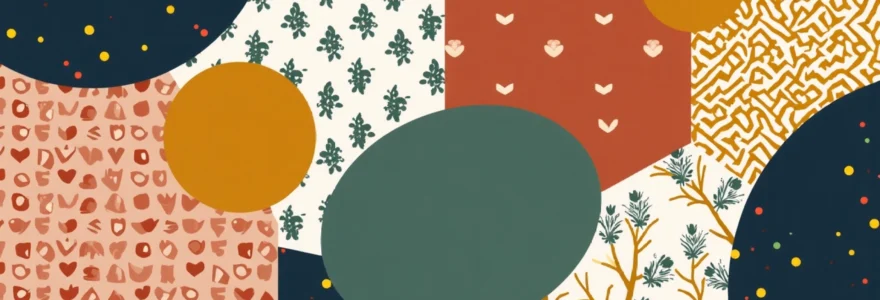
Pattern mixing represents one of interior design’s most sophisticated challenges, requiring a delicate balance between creative expression and visual harmony. When executed successfully, multiple patterns can transform a space from mundane to magnificent, creating layers of interest that draw the eye and engage the senses. However, the line between artfully curated and chaotically overwhelming remains razor-thin, demanding careful consideration of scale, colour relationships, and spatial distribution.
The contemporary approach to pattern integration has evolved significantly from traditional matching sets, embracing a more eclectic sensibility that reflects personal style whilst maintaining coherent design principles. Understanding how different patterns interact visually, compete for attention, or complement one another forms the foundation of successful pattern mixing. This knowledge empowers you to create interiors that feel both dynamic and restful, sophisticated yet approachable.
Understanding scale, proportion, and visual weight in pattern combinations
The relationship between pattern scale and visual perception forms the cornerstone of successful pattern mixing. Large-scale patterns command immediate attention, functioning as focal points that anchor a room’s design narrative. Medium-scale patterns serve as transitional elements, bridging the gap between bold statements and subtle accents. Small-scale patterns provide textural interest without competing for dominance, creating visual rest areas that prevent sensory overload.
Understanding visual weight extends beyond physical size to encompass colour intensity, contrast levels, and pattern density. A delicate floral print in vibrant coral carries significantly more visual weight than a geometric pattern in muted grey tones, despite potentially identical physical dimensions. This principle guides the strategic placement of patterns throughout a space, ensuring balanced distribution that feels both intentional and effortless.
Fibonacci ratio applications in Large-Scale geometric patterns
The golden ratio, derived from the Fibonacci sequence, provides a mathematical foundation for pleasing proportional relationships in pattern combinations. When applying large-scale geometric patterns, consider the 1.618:1 ratio for determining optimal size relationships between primary and secondary patterns. This approach creates natural visual harmony that resonates with human perception, making pattern combinations feel inherently balanced rather than forced or arbitrary.
Small-scale motif integration with dominant pattern elements
Small-scale motifs require careful integration to avoid becoming lost amongst larger pattern statements. The key lies in strategic placement where these delicate patterns can shine without competition—perhaps on lamp shades, cushion piping, or as accent borders. Consider how minute florals might echo the organic curves found in a room’s dominant paisley wallpaper, creating subtle connections that enhance rather than diminish the overall design impact.
Visual hierarchy through pattern density variation
Creating clear visual hierarchy prevents pattern chaos whilst maintaining interest throughout the space. Dense, complex patterns naturally assume prominence, whilst sparser designs recede into supporting roles. This principle allows you to orchestrate a room’s visual flow, guiding the eye from focal points to rest areas in a deliberate, comfortable progression that feels both engaging and restful.
Colour saturation impact on pattern prominence
Colour saturation dramatically influences how patterns compete for attention within a space. Highly saturated patterns advance visually, demanding immediate notice, whilst desaturated versions of the same design retreat into the background. This understanding enables precise control over pattern hierarchy, allowing you to emphasise certain elements whilst maintaining supporting patterns that add depth without overwhelming the composition.
Classical pattern pairing principles: stripes, florals, and geometric motifs
Traditional pattern combinations offer time-tested formulas that continue to deliver sophisticated results in contemporary interiors. These classical pairings provide reliable starting points for those new to pattern mixing, whilst offering endless variations for experienced designers seeking fresh interpretations. The enduring appeal of certain combinations stems from their inherent complementary characteristics—organic curves balancing geometric precision, regular rhythms offsetting irregular motifs.
The most successful pattern combinations often pair organic and geometric elements, creating a visual dialogue between nature’s irregularity and human-imposed order.
Toile and ticking stripe combinations in french provincial design
The marriage of pastoral toile and crisp ticking stripes exemplifies French provincial elegance, offering a sophisticated contrast between narrative imagery and geometric precision. This combination works particularly well when the stripe scale complements rather than competes with the toile’s pictorial elements. Consider using medium-width stripes that echo the vertical elements within toile scenes, creating subtle visual connections that enhance both patterns’ individual characteristics.
William morris botanical prints with contemporary linear patterns
Morris’s intricate botanical designs gain fresh relevance when paired with clean, contemporary linear patterns. The organic complexity of Arts and Crafts florals benefits from the visual respite provided by simple geometric companions. This juxtaposition creates temporal dialogue between historical craftsmanship and modern minimalism, resulting in interiors that feel both timeless and current.
Ikat chevron integration with traditional paisley motifs
The fluid, organic nature of ikat chevron patterns complements the curved sophistication of paisley motifs, creating globally-inspired combinations that feel both exotic and refined. The key to success lies in maintaining consistent colour temperatures across both patterns, allowing their different cultural origins to harmonise rather than clash. Consider how the directional flow of chevron patterns can guide the eye towards focal points featuring paisley elements.
Tartan plaid layering with Micro-Dot and Pin-Spot designs
Traditional tartan gains contemporary appeal when layered with delicate micro-dot patterns that echo the plaid’s intersection points. This combination requires careful attention to scale relationships—pin-spots should be significantly smaller than tartan squares to avoid visual confusion. The regular grid structure of both patterns creates natural affinity, whilst their different scales prevent monotonous repetition.
Chinoiserie bird patterns balanced with bamboo lattice geometrics
The flowing, narrative quality of chinoiserie bird motifs finds perfect complement in the structured geometry of bamboo lattice patterns. This pairing exemplifies how patterns from the same cultural tradition can enhance each other through contrasting characteristics. The lattice provides visual grounding for the birds’ movement, whilst the organic motifs soften the geometry’s rigid structure.
Colour theory applications in Multi-Pattern interior schemes
Successful pattern mixing relies heavily on sophisticated colour relationships that unify disparate elements whilst maintaining visual interest. Understanding how colours interact across different patterns enables you to create cohesive schemes that feel intentional rather than accidental. The strategic use of colour can make even the most unlikely pattern combinations work harmoniously, whilst poor colour choices can sabotage otherwise compatible designs.
Consider how different colour temperatures affect pattern relationships—warm tones tend to advance and energise, whilst cool colours recede and calm. This principle allows you to manipulate spatial perception whilst coordinating multiple patterns. The interplay between warm and cool tones across patterns creates natural depth and dimension that enhances rather than compromises the overall design integrity.
Analogous colour palette coordination across diverse pattern types
Analogous colour schemes—those using neighbouring hues on the colour wheel—provide natural harmony that allows diverse pattern types to coexist peacefully. This approach works particularly well when combining patterns with different cultural or stylistic origins, as the unified colour story creates coherence despite diverse pattern languages. Consider how blues transitioning through blue-greens to greens can unite florals, geometrics, and abstracts in a single, sophisticated scheme.
Monochromatic layering with varying pattern textures
Monochromatic pattern schemes challenge designers to create interest through texture, scale, and pattern type rather than colour contrast. This approach often yields the most sophisticated results, as the eye focuses on pattern relationships rather than colour drama. Varying the texture of pattern application—smooth cotton florals against nubby wool geometrics—adds tactile interest that enhances the visual complexity of monochromatic schemes.
Complementary accent integration in Pattern-Heavy environments
Complementary colours create vibrant contrast that can energise pattern-heavy spaces, but require careful handling to avoid visual chaos. The key lies in using complementary relationships as accents rather than dominant themes, allowing the colour contrast to highlight specific pattern elements without overwhelming the overall composition. Consider how small touches of orange might activate a predominantly blue pattern scheme, creating focal points that enhance rather than dominate the design.
Neutral base strategy for High-Contrast pattern combinations
Neutral foundations provide essential visual grounding for bold pattern combinations, offering the eye places to rest whilst allowing patterns to maintain their individual character. The strategic use of neutrals—whether through solid-coloured furniture, plain walls, or textured but unpatterned accessories—prevents pattern overload whilst maintaining design sophistication. This approach enables you to use more adventurous pattern combinations than would otherwise be possible.
Textile application techniques across different interior elements
The physical application of patterns across various interior elements requires strategic thinking about hierarchy, durability, and visual impact. Different surfaces offer distinct opportunities for pattern placement, each with unique considerations regarding scale, maintenance, and design longevity. Understanding these nuances enables you to maximise pattern impact whilst ensuring practical functionality.
Wall applications provide the largest canvas for pattern display, making them ideal for establishing a room’s primary pattern story. However, this prominence requires careful consideration of pattern scale and intensity—what works beautifully on a single accent wall might overwhelm when applied to all four walls. Floor patterns face different challenges, needing to withstand heavy traffic whilst providing visual foundation without competing with furniture and accessories.
Upholstery patterns offer opportunities for both bold statements and subtle accents, depending on the furniture piece’s prominence and function. Large sofas can carry significant pattern weight, becoming room focal points, whilst occasional chairs might feature more adventurous designs that add personality without overwhelming the space. Window treatments present unique considerations, as their patterns must work both when drawn and when natural light filters through them.
The key to successful pattern application lies in understanding each element’s role within the room’s visual hierarchy and selecting patterns that support rather than compete with this intended function. Accessories provide the final layer of pattern integration, offering opportunities for seasonal updates and personal expression through cushions, throws, artwork, and decorative objects. These elements can introduce accent colours, echo dominant patterns, or provide necessary visual bridges between larger pattern statements.
Strategic pattern placement across different interior elements creates layers of visual interest that transform static spaces into dynamic, engaging environments that evolve with changing light and usage patterns.
Advanced pattern distribution methods in Open-Plan living spaces
Open-plan environments present unique challenges for pattern distribution, requiring careful consideration of sightlines, functional zones, and visual flow between areas. The absence of walls to contain patterns demands sophisticated strategies for maintaining coherence across large spaces whilst allowing individual areas to maintain distinct character. Successful pattern distribution in open plans relies on understanding how patterns relate across distance and how they can define spaces without physical barriers.
Zoning through pattern offers an elegant solution for defining functional areas within open spaces. Different pattern families can delineate cooking, dining, and seating areas whilst maintaining overall coherence through shared colour palettes or complementary motifs. This approach allows each zone to develop its own personality whilst contributing to the larger design narrative.
Visual pathways created through strategic pattern placement guide movement through open spaces whilst creating natural focal points and rest areas. Consider how a patterned rug might lead from the entrance towards a seating area featuring complementary patterns, creating a journey of visual discovery that feels both intentional and organic. The rhythm of pattern placement across large spaces can create dynamic energy or peaceful flow, depending on the desired atmospheric goals.
Scale relationships become even more critical in open plans, where patterns must work both at intimate viewing distances and from across large spaces. Patterns that appear perfectly balanced when viewed closely might disappear or become overwhelming when seen from the opposite end of a large room. This requires careful consideration of how different patterns perform at various scales and distances.
Lighting considerations significantly impact pattern perception in open environments, where natural and artificial light sources create varying conditions throughout the day. Patterns that work beautifully in morning light might appear completely different under evening artificial illumination. Understanding these changes enables you to select patterns that maintain their intended impact regardless of lighting conditions, ensuring consistent visual quality throughout daily usage cycles.
Professional design tools for pattern visualisation and planning
Contemporary design professionals increasingly rely on sophisticated visualisation tools that enable precise pattern coordination before committing to final selections. Digital mood boards allow experimentation with pattern combinations, scale relationships, and colour variations without the expense and time commitment of physical samples. These tools prove particularly valuable when working with clients who struggle to visualise complex pattern relationships from traditional sample books.
3D rendering software provides realistic previews of how patterns will appear in actual room conditions, accounting for lighting, scale, and spatial relationships that flat mood boards cannot accurately represent. Advanced rendering capabilities now include realistic fabric textures, lighting simulation, and even seasonal variation modeling, enabling designers to present comprehensive pattern schemes that clients can fully understand before implementation begins.
Colour matching technology ensures accurate coordination between patterns from different manufacturers, eliminating the guesswork traditionally associated with combining elements from various sources. Spectrophotometer readings provide precise colour data that enables confident mixing of patterns that might appear compatible in showroom lighting but clash under home conditions.
Sample management systems help track pattern availability, lead times, and coordination requirements across complex projects involving multiple pattern elements. Digital cataloguing with detailed colour and texture information streamlines the selection process whilst reducing the risk of coordination errors that can compromise final results. These systems prove particularly valuable for large projects requiring pattern coordination across multiple rooms or phases of installation.
Virtual reality applications now enable clients to experience pattern combinations in immersive environments that provide accurate scale and spatial relationships. This technology proves particularly valuable for pattern-heavy schemes where clients need confidence in complex combinations before making substantial investments in custom elements. The ability to “walk through” spaces featuring proposed pattern combinations significantly reduces revision cycles and ensures final satisfaction with adventurous pattern choices.