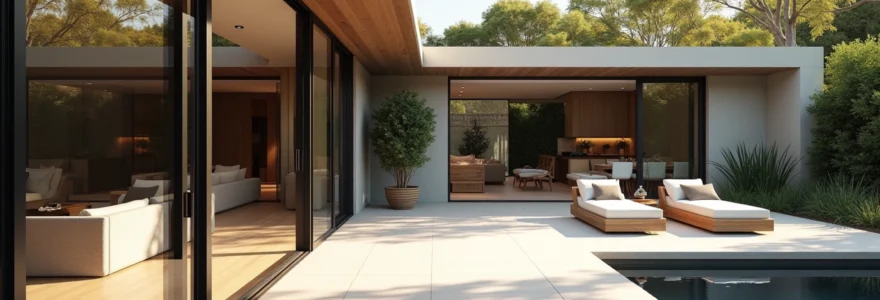
The boundaries between interior and exterior spaces have become increasingly fluid in contemporary architectural design, reflecting our desire to live in harmony with nature whilst maintaining the comforts of modern living. This shift towards seamless indoor-outdoor integration represents more than a passing trend—it embodies a fundamental rethinking of how we inhabit and experience our homes. The sophisticated orchestration of architectural elements, materials, and environmental systems creates spaces that breathe naturally between inside and outside, offering enhanced quality of life and elevated property values.
Achieving this delicate balance requires careful consideration of multiple design factors, from structural glazing systems to climate control mechanisms. The modern homeowner expects spaces that adapt effortlessly to changing weather conditions whilst maintaining aesthetic continuity. Smart styling choices form the backbone of successful indoor-outdoor integration, creating environments that feel cohesive regardless of seasonal variations.
Architectural elements for dissolving Interior-Exterior boundaries
The structural foundation of seamless indoor-outdoor living begins with deliberate architectural interventions that challenge traditional concepts of separation. Contemporary design philosophy embraces the notion that walls need not be barriers but rather permeable membranes that facilitate controlled interaction between interior and exterior environments. This approach requires sophisticated understanding of building physics, weather resistance, and human comfort factors.
Floor-to-ceiling glazing systems and curtain wall applications
Floor-to-ceiling glazing represents perhaps the most dramatic method of connecting interior and exterior spaces, creating an almost invisible barrier that maintains environmental control whilst maximising visual connectivity. Modern glazing systems incorporate advanced thermal performance characteristics, with triple-glazed units achieving U-values as low as 0.7 W/m²K whilst maintaining exceptional optical clarity. These systems often feature structural glazing techniques that eliminate visible mullions, creating uninterrupted expanses of transparency.
Curtain wall applications extend this concept to entire building facades, creating a continuous glazed envelope that responds dynamically to changing light conditions throughout the day. High-performance coatings and intelligent glass technologies enable these systems to modulate solar gain whilst preserving views and natural light penetration. The integration of automated blinds or electrochromic glass adds another layer of environmental control, allowing occupants to fine-tune their connection to the outdoors.
Bi-fold and sliding door mechanisms: schuco ASS 77 PD and similar systems
Advanced sliding and bi-fold door systems represent the pinnacle of operable glazing technology, offering the ability to completely dissolve the boundary between interior and exterior spaces when weather conditions permit. The Schuco ASS 77 PD system exemplifies this technology, featuring precision-engineered tracks and hardware that enable panels weighing up to 400kg to operate with minimal effort. These systems incorporate sophisticated weather sealing technologies that maintain performance standards even in challenging climatic conditions.
The engineering behind these mechanisms involves complex considerations of structural loading, thermal expansion, and weather resistance. Multi-point locking systems ensure security whilst maintaining the sleek aesthetic lines that characterise premium installations. When fully opened, these systems create apertures spanning up to 6 metres without intermediate supports, fundamentally transforming the spatial experience and creating genuine indoor-outdoor rooms.
Consistent flooring transitions using porcelain tiles and natural stone
Flooring continuity serves as perhaps the most psychologically powerful method of creating seamless transitions between interior and exterior spaces. The human eye naturally follows horizontal planes, and disruptions in flooring materials create immediate cognitive separation between spaces. Contemporary large-format porcelain tiles, available in dimensions up to 1200mm x 3600mm, enable virtually seamless transitions with minimal joint lines that further enhance the sense of continuity.
Natural stone applications offer inherent weather resistance whilst providing authentic texture and thermal mass properties that contribute to overall environmental comfort. Limestone and travertine selections, when properly sealed and finished, perform excellently in both interior and exterior applications. The key lies in selecting materials with appropriate slip resistance ratings for exterior use whilst maintaining the refined appearance expected in interior spaces.
Structural glazing techniques for minimising visual interruptions
Structural glazing represents the ultimate expression of transparency in architectural applications, eliminating visible framework elements that might interrupt sight lines between interior and exterior spaces. This technique relies on high-strength structural adhesives and precision engineering to transfer wind and seismic loads directly through the glazing assembly to the building structure. The result creates an almost magical sense of weightlessness, as large expanses of glass appear to float without visible means of support.
The engineering requirements for structural glazing demand exceptional attention to thermal movement, weather sealing, and long-term adhesive performance. Structural calculations must account for dynamic loading conditions whilst maintaining safety factors appropriate for glazed assemblies. When executed correctly, these systems create stunning visual effects that fundamentally alter the perception of interior and exterior boundaries.
Material palette coordination strategies
The success of indoor-outdoor integration depends heavily on the thoughtful coordination of material palettes that perform effectively in both interior and exterior environments. This coordination extends beyond simple aesthetic matching to encompass technical performance characteristics, maintenance requirements, and long-term durability considerations. The most successful projects achieve a delicate balance between visual continuity and practical functionality, creating spaces that feel cohesive whilst performing optimally in their respective environments.
Natural stone continuity: travertine and limestone applications
Natural stone selections offer inherent advantages for indoor-outdoor applications, providing authentic textures and thermal properties that enhance environmental comfort whilst maintaining visual consistency. Travertine, with its naturally occurring pores and organic texture, creates a sense of warmth and connection to natural processes that resonates equally well in interior and exterior applications. The material’s inherent thermal mass properties contribute to passive environmental conditioning, moderating temperature swings and creating more comfortable microclimates.
Limestone applications require careful selection based on porosity and weather resistance characteristics. Dense limestone varieties perform excellently in challenging weather conditions whilst providing the refined appearance expected in premium interior applications. The key lies in understanding the specific performance characteristics of different limestone types and selecting appropriately for each application. Proper sealing and maintenance protocols ensure long-term performance whilst preserving the natural beauty that makes stone such an attractive material choice.
Timber species selection for weather resistance and aesthetic unity
Timber selection for indoor-outdoor applications requires careful consideration of species characteristics, grain patterns, and natural weather resistance properties. Hardwood species such as teak, ipe, and cumaru offer exceptional weather resistance whilst providing the warm, organic appearance that creates psychological comfort in living spaces. These species contain natural oils and dense cellular structures that resist moisture penetration and dimensional instability, ensuring long-term performance in challenging outdoor conditions.
The aesthetic unity achieved through consistent timber applications creates powerful visual connections between interior and exterior spaces. When the same species appears in interior flooring, exterior decking, and architectural details, the eye perceives a seamless continuation of material that reinforces the sense of spatial flow. Proper finishing and maintenance protocols ensure that indoor and outdoor timber applications age gracefully, developing the natural patina that enhances rather than detracts from their visual appeal.
Metal framework integration: weathering steel and Powder-Coated aluminium
Metal framework elements provide structural support whilst contributing to the overall aesthetic cohesion of indoor-outdoor spaces. Weathering steel, also known as Corten steel, develops a protective oxide layer that stabilises over time, creating a distinctive rust-coloured patina that harmonises beautifully with natural landscapes. This material performs exceptionally well in exterior applications whilst providing the industrial aesthetic that complements contemporary architectural styles.
Powder-coated aluminium systems offer exceptional durability and colour retention whilst providing the precision and consistency expected in premium architectural applications. Modern powder coating technologies enable complex colour matching and texture effects that can simulate other materials whilst providing superior weather resistance. The lightweight characteristics of aluminium enable large-span applications with minimal structural impact, creating opportunities for dramatic architectural gestures that enhance the indoor-outdoor connection.
Textile and soft furnishing Weather-Grade materials
Contemporary textile technologies enable the use of soft furnishings in transitional indoor-outdoor spaces without compromising on comfort or durability. Solution-dyed acrylic fibres provide exceptional colour fastness and weather resistance whilst maintaining the tactile qualities expected in interior applications. These materials resist fading, mould, and mildew whilst offering the design flexibility to create cohesive colour schemes that span interior and exterior spaces.
High-performance cushioning materials utilise open-cell foam technologies that drain rapidly whilst maintaining comfort characteristics. These innovations enable the use of upholstered furniture in covered outdoor areas without the maintenance challenges associated with traditional materials. The resulting design flexibility allows for sophisticated colour and texture coordination that enhances the sense of spatial continuity between indoor and outdoor areas.
Lighting design for transitional spaces
Lighting design for indoor-outdoor spaces requires sophisticated understanding of human circadian rhythms, task requirements, and aesthetic considerations that span both interior and exterior environments. The most successful installations create seamless transitions between artificial and natural light sources whilst providing appropriate illumination levels for various activities throughout the day and evening hours. This coordination involves careful selection of fixture types, lamp technologies, and control systems that respond dynamically to changing conditions.
Natural light management forms the foundation of effective transitional space lighting, utilising architectural elements to modulate and direct sunlight in ways that enhance rather than overwhelm interior spaces. Automated systems can adjust artificial lighting levels in response to natural light availability, creating consistent ambient conditions regardless of weather or time of day. Circadian lighting systems that adjust colour temperature throughout the day help maintain healthy sleep patterns whilst creating dynamic visual interest.
Exterior lighting systems must integrate seamlessly with interior schemes whilst addressing security, safety, and landscape enhancement requirements. LED technologies offer exceptional energy efficiency and longevity whilst providing the design flexibility to create complex lighting scenarios. Colour-changing capabilities enable seasonal adjustments that maintain visual harmony between indoor and outdoor spaces throughout the year.
The integration of smart lighting controls enables sophisticated programming that responds to occupancy, weather conditions, and time of day, creating truly adaptive environments that enhance the indoor-outdoor living experience.
Path lighting and accent lighting create visual continuity between interior and exterior circulation routes, guiding movement whilst highlighting architectural and landscape features. The key lies in achieving appropriate contrast ratios that provide safety and navigation cues without creating harsh transitions between light and shadow. Careful attention to fixture placement and beam angles ensures that lighting enhances rather than competes with architectural elements.
Climate control and environmental management
Effective climate control in indoor-outdoor spaces requires sophisticated systems that can adapt to rapidly changing environmental conditions whilst maintaining occupant comfort. Traditional HVAC approaches prove inadequate for spaces with large operable openings, necessitating innovative approaches that combine passive and active environmental strategies. The most successful installations utilise radiant heating and cooling systems that provide comfort without relying on air movement, making them ideal for spaces with frequent air exchange with the exterior.
Radiant floor heating systems offer particular advantages in transitional spaces, providing consistent warmth that feels natural and comfortable even when doors are open to outdoor areas. These systems respond slowly to temperature changes, providing thermal stability that moderates the effects of air exchange with exterior spaces. When combined with thermal mass elements such as stone flooring, radiant systems create comfortable microclimates that extend the usable season for indoor-outdoor living.
Cooling strategies for transitional spaces often rely on natural ventilation principles combined with targeted mechanical systems. High-velocity, low-volume fans create comfortable air movement whilst consuming minimal energy. Evaporative cooling systems can provide effective temperature reduction in appropriate climates whilst maintaining the natural feel that characterises successful indoor-outdoor spaces.
Humidity control presents particular challenges in spaces with frequent air exchange between interior and exterior environments. Desiccant-based systems offer effective moisture management without the energy penalties associated with traditional refrigeration-based dehumidification. These systems work particularly well in coastal environments where traditional systems struggle to maintain comfort conditions.
Smart environmental monitoring systems that track temperature, humidity, and air quality enable automated responses that maintain optimal conditions whilst minimising energy consumption and maximising occupant comfort.
Furniture selection and spatial programming
Furniture selection for seamless indoor-outdoor spaces demands careful consideration of materials, construction methods, and spatial programming requirements that span both environmental conditions. The most successful installations feature pieces that feel equally appropriate in interior and exterior settings whilst providing the comfort and functionality expected in contemporary living spaces. This balance requires understanding of advanced materials technologies and construction techniques that resist weathering whilst maintaining aesthetic appeal.
All-weather furniture materials: teak, synthetic rattan, and Marine-Grade fabrics
Teak represents the gold standard for outdoor furniture applications, offering exceptional weather resistance due to its high oil content and dense cellular structure. The natural oils in teak provide inherent protection against moisture, insects, and UV degradation whilst developing an attractive silver-grey patina over time. When properly constructed with appropriate joinery techniques, teak furniture can provide decades of service in challenging outdoor environments whilst maintaining structural integrity and aesthetic appeal.
Synthetic rattan technologies have evolved dramatically in recent years, offering the visual appeal of natural materials with superior weather resistance and dimensional stability. High-quality synthetic rattan utilises UV-stabilised polyethylene construction that resists fading and cracking whilst maintaining flexibility in temperature extremes. The best examples feature realistic textures and colour variations that closely mimic natural materials whilst providing consistent performance characteristics.
Marine-grade fabrics incorporate solution-dyed fibres and advanced weaving techniques that provide exceptional durability in challenging outdoor environments. These materials resist fading, mould, and degradation from salt air whilst maintaining the tactile qualities expected in premium furnishings. The design flexibility offered by these materials enables sophisticated colour coordination that spans interior and exterior applications.
Modular seating systems for flexible Indoor-Outdoor configuration
Modular seating systems provide the flexibility required for spaces that serve multiple functions throughout the day and seasons. These systems enable rapid reconfiguration for different activities whilst maintaining the refined appearance expected in premium interior spaces. The key lies in selecting systems with robust connection methods and weather-resistant construction that can withstand frequent movement and reconfiguration.
Contemporary modular systems incorporate lightweight materials and ergonomic design principles that make reconfiguration effortless whilst providing exceptional comfort for extended use. Integrated storage solutions enable cushions and accessories to be protected when not in use, extending their lifespan whilst maintaining appearance standards. The best systems feature coordinated occasional tables and accessories that enhance functionality whilst maintaining aesthetic cohesion.
Storage solutions for seasonal transition management
Effective storage solutions enable seamless transitions between seasonal configurations whilst protecting valuable furnishings and accessories from weather exposure. Built-in storage benches and console units provide convenient access to cushions, throws, and seasonal decorative elements whilst contributing to the overall design aesthetic. These solutions must incorporate appropriate ventilation and moisture management to prevent mould and mildew development during storage periods.
Climate-controlled storage areas adjacent to outdoor spaces enable protection of premium furnishings whilst maintaining easy access for seasonal changeovers. These spaces benefit from automated ventilation systems that maintain appropriate humidity levels whilst preventing condensation. Careful planning of storage layouts enables efficient organisation whilst minimising the effort required for seasonal transitions.
Integrated storage solutions that blend seamlessly with architectural elements provide necessary functionality whilst maintaining the clean, uncluttered aesthetic that characterises successful indoor-outdoor spaces.
Landscape integration and biophilic design principles
Landscape integration forms the final layer of successful indoor-outdoor design, creating visual and experiential connections that reinforce the seamless flow between built and natural environments. Biophilic design principles guide this integration, recognising the fundamental human need for connection with natural systems and processes. The most successful projects create carefully orchestrated sequences of indoor and outdoor gardens that feel like natural extensions of each other whilst providing appropriate scale and enclosure for different activities.
Plant selection for transitional spaces requires understanding of both horticultural requirements and design aesthetic considerations. Species that perform well in both interior and exterior applications create powerful visual connections whilst simplifying maintenance requirements. Large-scale planters enable significant landscape statements in covered outdoor areas whilst providing the root volume required for healthy plant growth. These installations often incorporate automated irrigation systems that ensure consistent plant health whilst minimising maintenance requirements.
Water features provide both visual and auditory connections to natural processes whilst contributing to microclimate modification through evaporative cooling. Contemporary water feature design utilises sophisticated filtration and circulation systems that maintain water quality whilst minimising maintenance requirements. The sound of moving water helps mask urban noise whilst creating the sense of tranquillity that characterises successful outdoor living spaces.
Vertical garden systems extend landscape integration to wall surfaces, creating dramatic visual impacts whilst improving air quality and providing natural cooling through evapotranspiration. These systems require sophisticated irrigation and drainage solutions but offer exceptional design flexibility in constrained urban environments. The integration of automated monitoring systems ensures optimal growing conditions whilst alerting homeowners to maintenance requirements before problems develop.
Seasonal interest programming ensures that landscape elements provide visual appeal throughout the year, with careful selection of plants that offer different characteristics in different seasons. This programming includes consideration of flowering periods, foliage changes, and structural elements that provide winter interest. The goal creates dynamic outdoor spaces that feel fresh and engaging throughout the yearly cycle whilst maintaining the visual connections that reinforce indoor-outdoor integration.
The thoughtful integration of native plant communities creates authentic connections between cultivated and natural environments, blurring the distinction between formal garden spaces and existing landscape contexts. Strategic placement of specimen trees provides focal points that anchor outdoor spaces whilst creating natural canopies that moderate harsh sunlight and provide psychological comfort. These larger landscape elements serve as transitional features that help the eye move naturally from architectural elements to the broader landscape context.
Hardscape integration utilises natural stone pathways and retaining walls that echo the material palette of interior spaces whilst providing necessary functionality for outdoor circulation and level changes. These elements should appear to emerge naturally from the landscape rather than imposing artificial geometry onto natural forms. The careful coordination of joint patterns, stone selection, and mortar colour ensures that hardscape elements enhance rather than compete with both architectural and landscape features.
Lighting integration within landscape elements extends the usable hours of outdoor spaces whilst creating dramatic visual effects that enhance the architectural composition. Uplighting of significant trees and architectural features creates layers of visual interest that change throughout the evening hours. Low-level pathway lighting provides safety whilst maintaining the intimate scale that characterises successful outdoor living spaces. The integration of programmable LED systems enables seasonal adjustments and special event lighting that maintains visual harmony with interior lighting schemes.
Successful biophilic design creates an intuitive understanding that interior and exterior spaces form part of a unified living environment, where natural processes and human comfort requirements work in harmonious balance.
The micro-climate benefits of strategic landscape integration extend beyond aesthetic considerations to provide measurable improvements in environmental performance. Deciduous trees positioned to shade large glazed areas during summer months whilst allowing solar gain during winter periods contribute significantly to overall energy efficiency. The evapotranspiration from landscape elements provides natural cooling whilst improving air quality around outdoor living areas. These environmental benefits reinforce the connection between human comfort and natural systems whilst reducing reliance on mechanical environmental control systems.
Maintenance planning for integrated landscape systems requires understanding of seasonal requirements and long-term growth patterns. Automated irrigation systems with weather monitoring capabilities ensure optimal plant health whilst minimising water consumption and maintenance labour. The selection of appropriate mulching materials and soil amendments creates sustainable growing environments that require minimal intervention once established. Professional maintenance schedules should account for seasonal pruning, fertilisation, and pest management requirements whilst preserving the natural character that makes these landscapes successful.
The successful creation of seamless indoor-outdoor flow represents a sophisticated orchestration of architectural, material, environmental, and landscape systems that work together to create spaces fundamentally different from traditional interior or exterior environments. These transitional spaces offer enhanced quality of life through their connection to natural systems whilst providing the comfort and functionality expected in contemporary living. The investment in proper design and execution of these systems yields both immediate lifestyle benefits and long-term property value enhancement, making them an increasingly important consideration in residential design and renovation projects.